Best Central Seville Neighbourhoods to Stay Without a Car
The best area to stay in Seville without a car is Santa Cruz or El Arenal — both walkable to the Cathedral, tapas bars, and the river. Full neighbourhood breakdown inside.
Best Area to Stay in Seville Without a Car
If you're only in Seville for two, three, maybe four nights, the question of where to sleep is actually the most important decision you'll make. Get it wrong — book something cheap near the train station on the northern edge of the centre — and you'll spend your limited time on buses and taxis instead of wandering through orange-tree courtyards at dusk. The short answer: Santa Cruz and El Arenal are the two neighbourhoods that make the most sense if you have no car and a short window. Both put you within ten minutes' walk of almost everything worth seeing, and neither requires you to understand Seville's bus network, which is perfectly functional but genuinely confusing for a first-timer.
Below is a proper breakdown of the main central barrios — what each one is actually like to stay in, what you'll pay, and where to skip.
Santa Cruz: The Obvious Choice, and Rightly So
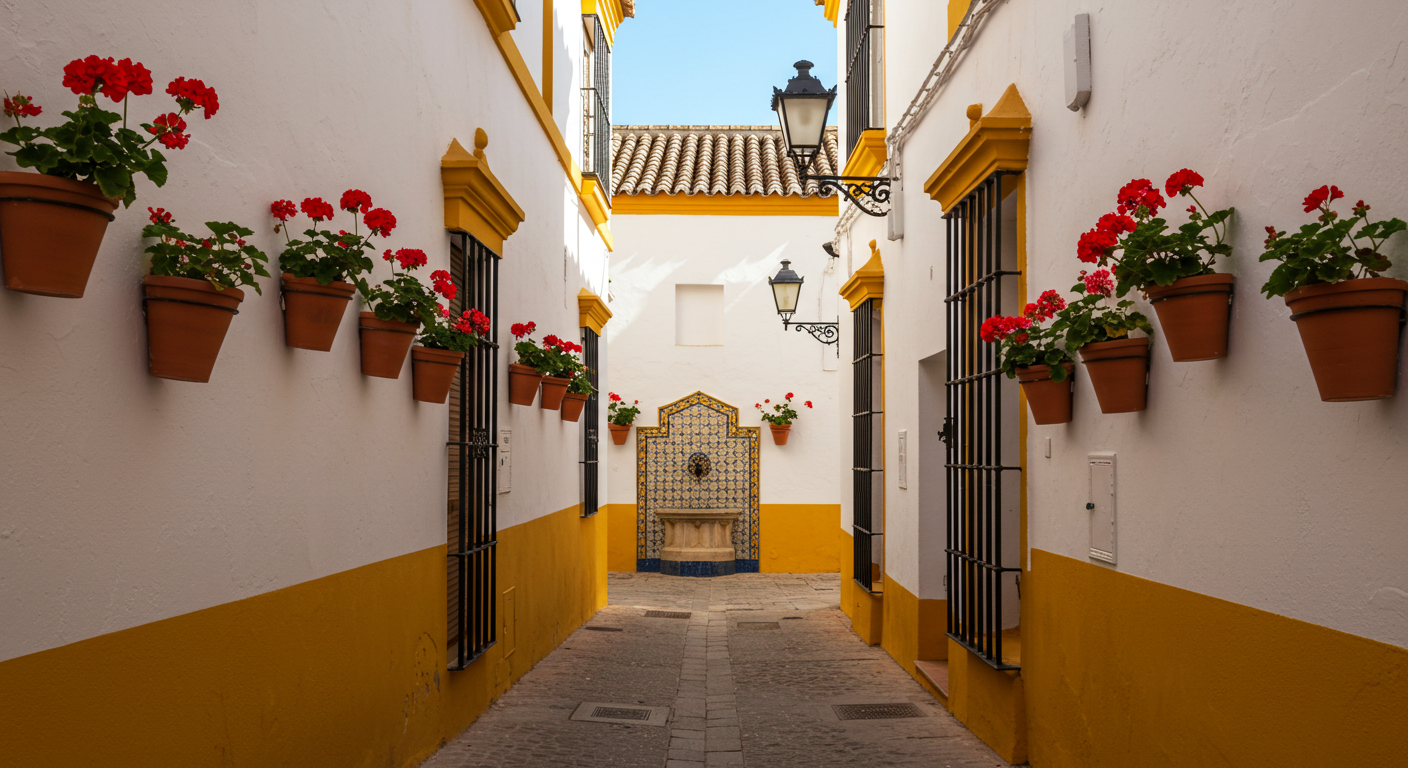
Santa Cruz is the old Jewish quarter, a tight maze of whitewashed lanes that feels absurd in the best possible way — like someone designed a neighbourhood specifically for postcards. It's immediately east of the Cathedral and the Alcázar, which means you can roll out of bed and be at the entrance to the Alcázar gardens in under five minutes.
The streets are genuinely car-free in most of the barrio. That's not a marketing phrase; it's a physical fact. Many alleys are too narrow for anything wider than a bicycle. This makes it the single most pedestrian-friendly neighbourhood in the city, and the one that rewards wandering without a plan.
Accommodation here runs the full range. A decent mid-range hotel — something like a small boutique place on or just off Calle Mateos Gago — will cost you roughly €100–€160 per night in shoulder season (March–May, October), and noticeably more in April during Semana Santa or the Feria de Abril, when prices across the city spike hard. Budget options exist in the form of guesthouses and pensiones, some of which are genuinely charming and some of which are just cheap. Read recent reviews carefully; noise is the main issue. The neighbourhood is lively until late, particularly around Plaza de los Venerables and Calle Mesón del Moro.
The downside of Santa Cruz is that it's the most visited neighbourhood in the city. In high summer (July–August), the lanes fill up with tour groups between about 10am and 2pm. It becomes your own again after siesta and again after dark. If that crowds-in-the-morning pattern bothers you, El Arenal is quieter and equally well-placed.
El Arenal: Quieter, Still Central, Underrated
El Arenal sits between the Cathedral and the Guadalquivir river, roughly west of Santa Cruz. It's a bit more lived-in and a bit less photogenic, which means it attracts fewer tour groups. The Torre del Oro is here. The Plaza de Toros is here. And the riverside promenade — the Paseo de Cristóbal Colón — is a five-minute walk, which matters more than you'd think on a warm Sevillian evening.
Staying in El Arenal puts you on the doorstep of some of the city's better tapas bars: the ones that haven't quite made it onto every travel blog yet. Bar El Comercio on Calle Lineros is worth finding. The montaditos at Bodega Dos de Mayo on Plaza de la Gavidia (just north of the barrio boundary) are as good as anything in the Santa Cruz tourist belt, and cheaper.
Hotels here tend to be slightly more business-oriented — a few four-star places that cater to conference visitors — but there are also some solid mid-range options. Expect to pay roughly €90–€140 per night in shoulder season for something comfortable. It's marginally less expensive than the heart of Santa Cruz for equivalent quality.
El Centro: Practical, Slightly Soulless
El Centro is the area around Calle Sierpes, the pedestrian shopping street, and Plaza Nueva, where the Ayuntamiento sits. It's undeniably central — equidistant from the Cathedral, the Metropol Parasol (locally called Las Setas, worth going up at sunset), and the river. If you're here partly for shopping or if you want somewhere that feels more like a real city and less like a heritage attraction, this works.
The issue is atmosphere. El Centro by day is busy and urban; by night, once the shops close, it quietens down in a way that feels slightly empty rather than peaceful. It's not unpleasant, just less characterful than the barrios on either side. Hotels here are often larger chain properties. Fine, but not memorable.
Price-wise, you can sometimes find better value here than in Santa Cruz for the same standard, precisely because it lacks the romance premium.
Triana: Lovely, But You'll Need the Bridge
Everyone falls in love with Triana on a Seville trip, and understandably so. It's on the west bank of the Guadalquivir, traditionally the neighbourhood of flamenco artists and ceramics workshops, and it has a different energy from the tourist-heavy east bank — more local, more neighbourhood-feeling, better for watching daily Sevillian life.
But if you're without a car and on a short visit, think carefully before basing yourself here. The Puente de Isabel II (Triana bridge) is a fifteen-minute walk from the Cathedral at a decent pace. That's fine once, but when you're doing it three or four times a day with the sun hammering down in May, it adds up. Triana is better as a destination for a morning or an evening than as a base for a two-night trip.
If you're staying four or five nights and want to feel like less of a tourist, Triana makes more sense. For a flying visit, it's a romantic idea that slightly punishes you in practice.
La Macarena: Authentic, but Too Far North
La Macarena is where a lot of the city's younger residents actually live. It has good bars, a famous basilica, and the long stretch of old city walls. It's also a solid twenty-five-minute walk from the Cathedral, which is fine if you're staying a week, but too much friction for a short trip without wheels.
Skip it as a base. Visit it on an afternoon instead — take a taxi up, walk back via Alameda de Hércules (Seville's liveliest bar street), and you've done it properly.
What to Actually Book, and a Few Practical Notes
For most people doing two to four nights in Seville without a car, the decision is really between Santa Cruz and El Arenal. Santa Cruz if you want to be in the thick of it and don't mind the morning crowds. El Arenal if you prefer slightly more breathing room and a riverside walk before breakfast.
A few things nobody tells you clearly enough:
- The Cathedral area has significant pedestrianisation. Taxis and rideshares (Uber and Cabify both operate in Seville) can get close but not always to the door of your accommodation. Check this before you book, especially if you're arriving with heavy luggage from Santa Justa station.
- Seville in July and August is extremely hot. Temperatures regularly exceed 40°C. Air conditioning in your accommodation is not optional; it's a health matter. Check it's actually there and working — not just listed.
- The airport (San Pablo, SVQ) is about 10km northeast of the centre. A taxi costs roughly €25–€30. There's also a dedicated airport bus (EA line) that runs to the city centre for around €4, stopping at Puerta de Jerez, which is essentially the southern edge of El Arenal and Santa Cruz. It's a perfectly good option if you're travelling light.
- Semana Santa (Holy Week, date varies — late March or April) and Feria de Abril (two weeks after Semana Santa) are both extraordinary to witness, but accommodation prices double or treble and must be booked months in advance. Don't say you weren't warned.
If you're considering Seville as a longer base — or even a place to put down roots — the questions of paperwork and bureaucracy start to matter. The Spanish Digital Nomad Visa on Minimum Salary: Is It Worth It? piece on this site is worth reading if you're thinking about staying longer than a tourist. And if you eventually want to rent rather than stay in hotels, Renting in Spain Without a Spanish Payslip: How Foreigners Do It covers the real-world process in detail.
Getting Around Seville Without a Car
The city is genuinely one of Spain's most walkable. The historic centre is compact enough that, based in Santa Cruz or El Arenal, you can reach nearly every major sight on foot. The main things you'd want to see — Alcázar, Cathedral, Casa de Pilatos, Metropol Parasol, the river, the Triana market — are all within a thirty-minute walk of each other at most.
Seville also has an excellent public bike-hire system called Sevici (part of the JCDecaux network). Day passes cost a few euros and the bikes are everywhere. It's genuinely the fastest way to get around the centre and cross to Triana without the bridge walk feeling like a slog. Worth downloading the app before you arrive.
The metro exists but has limited relevance for central tourism — it's mainly useful for reaching outlying areas or the university district. The tram (Metrocentro line) runs along Avenida de la Constitución, right past the Cathedral, and connects to Plaza Nueva. One stop, essentially, but handy if you're catching a connection.
For the airport run, as mentioned, the EA bus is the sensible move. Taxis are metered and generally honest; Cabify tends to be slightly cheaper than street taxis for airport trips and you get a fixed price upfront.
One last thing: the heat changes how you navigate the city. Between noon and about 4pm from May through September, the streets genuinely empty out, and walking anywhere feels harder than it should. The locals aren't being dramatic when they disappear indoors — they've just lived here long enough to know. Plan your walking for the morning and the evening, and you'll enjoy the city far more.
Seville rewards the short visit done properly. Two nights in Santa Cruz, the Alcázar first thing in the morning before the crowds arrive, a long lunch somewhere with shade, a walk to Triana at sunset for a beer by the river. That's the shape of it.
Frequently asked questions
- What is the best area to stay in Seville without a car for a 2–3 night trip?
- Santa Cruz is the top pick — it's immediately next to the Cathedral and Alcázar, most of its streets are car-free, and you can walk to almost everything in the historic centre within 15 minutes. El Arenal (between the Cathedral and the river) is a close second and tends to be slightly quieter and marginally cheaper.
- Is Triana a good base in Seville if you don't have a car?
- Triana is charming but slightly inconvenient as a base for a short trip. You'll cross the Guadalquivir bridge multiple times a day to reach the main sights, which adds up in the heat. Better to visit Triana for an evening from a base on the east bank than to stay there on a flying visit.
- How do I get from Seville airport to the city centre without a car?
- The EA airport bus runs regularly between San Pablo airport and Puerta de Jerez (the southern edge of El Arenal and Santa Cruz) for around €4. Journey time is roughly 35–45 minutes depending on traffic. A taxi or Cabify runs around €25–€30 and takes about 20 minutes.
- How hot does Seville get, and does it affect walking around?
- Very. In July and August, temperatures frequently exceed 40°C. Between roughly noon and 4pm, walking significant distances is genuinely uncomfortable and potentially risky. Plan your sightseeing for early morning (the Alcázar opens at 9:30am) and the evening, when the city comes back to life from around 6–7pm onwards.
- When should I avoid staying in Seville due to crowds and high prices?
- Semana Santa (Holy Week, late March or April) and the Feria de Abril (two weeks later) are the most expensive and crowded periods. Accommodation prices can double or triple, and availability disappears fast. They're also genuinely spectacular if you're prepared — just book months ahead and accept the premium.
- Is there a bike hire scheme in Seville, and is it easy to use as a visitor?
- Yes — Sevici is Seville's public bike-share network, operated by JCDecaux and available across the city centre. Short-term day passes are available and the bikes are a practical way to cross to Triana or cover more ground without sweating through a long walk. Download the app before you arrive.
- Can I use Uber or Cabify in Seville?
- Both Uber and Cabify operate in Seville as of 2026. Cabify tends to offer fixed prices for airport routes, which can be useful for budgeting. Standard licensed taxis are also plentiful and metered. For the very centre of Santa Cruz, note that drivers may not be able to reach your exact address — check access when booking accommodation.