San Juan Beach Bonfires in Spain: Where to Go in 2026
San Juan beach bonfires in Spain: where to go, which cities do it best, what to expect on the night, and how to plan your trip for June 2026.
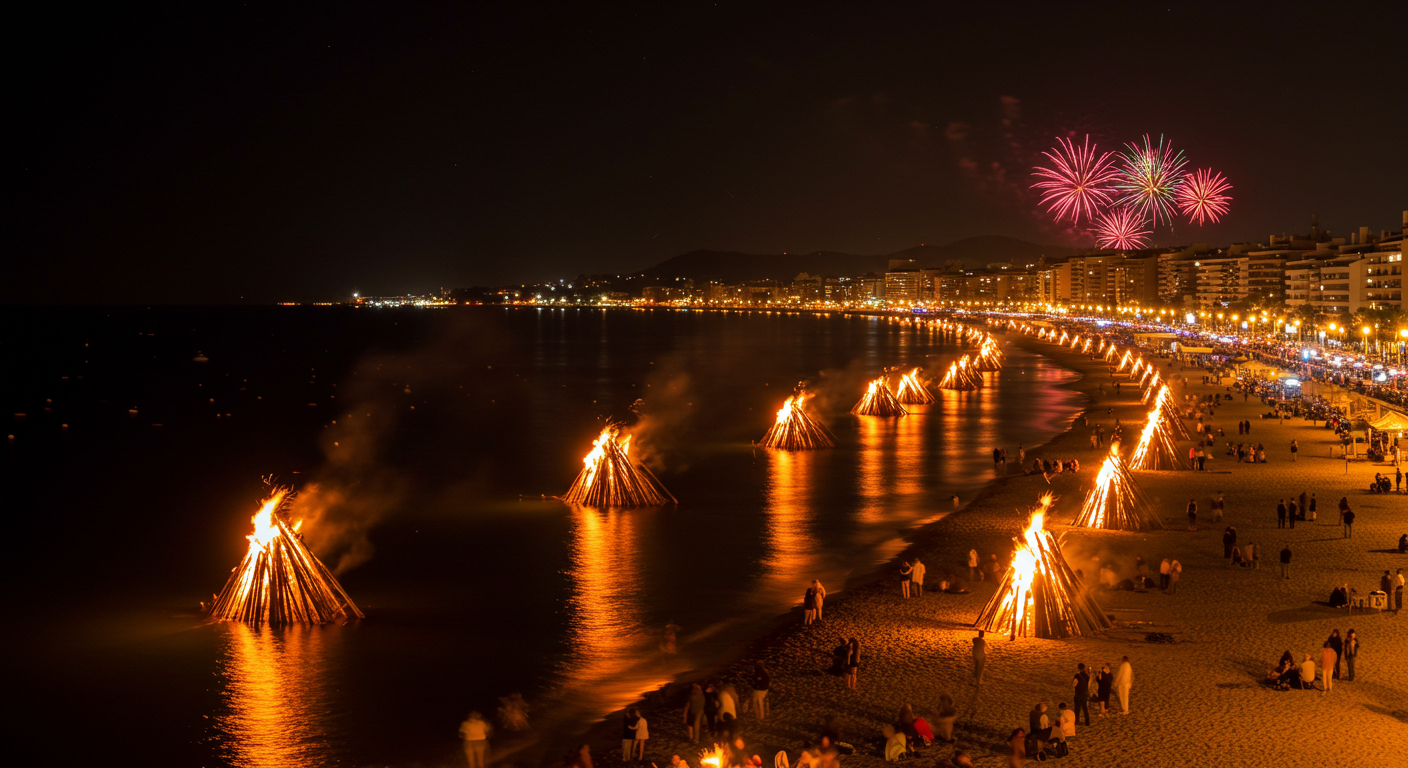
The night of 23rd June is one of the most genuinely spectacular things Spain does. Thousands of bonfires lit simultaneously along hundreds of kilometres of coastline, fireworks going off in every direction, people leaping over flames on the beach at midnight, and an atmosphere that no amount of organised festival infrastructure could replicate — because almost none of it is organised. This is Noche de San Juan, the midsummer bonfire night, and if you're in Spain in late June and you haven't planned around it, you're missing the best free show the country puts on all year.
The short answer: The best places to experience San Juan beach bonfires in Spain are A Coruña (Galicia), Valencia city, and Alicante — each with a very different character. A Coruña is the most ancient and atmospheric, Valencia mixes bonfires with a week-long city festival, and Alicante throws the biggest official fireworks display of the lot. The night of 23rd June is when it happens everywhere; arrive early, bring something to sit on, and expect the beach to be crowded by 10pm.
What Is Noche de San Juan?
The feast of Saint John the Baptist falls on 24th June, and Spain — like much of Europe — marks the eve with fire. The pagan roots go back further than the Christian feast: midsummer bonfires were lit across Celtic and pre-Roman Iberia to ward off evil spirits, welcome the summer solstice, and purify for the year ahead. The Catholic Church absorbed the date and the ritual largely survived intact.
What that means in practice today: you go to the beach, you light a bonfire (or join one already burning), you write down something you want to leave behind on a piece of paper and throw it in the flames, you jump over the fire an odd number of times for luck (three is the usual number), and at midnight — especially in Galicia — you dip your feet in the sea. There's wine, there's music, there's a lot of noise. It's not a ticketed event. It's just what people do.
A Coruña: The Most Atmospheric San Juan in Spain
If you only go to one San Juan bonfire in your life, go to A Coruña. The city's Galician name for the night is A Noite Meiga — the Night of the Witches — and the whole thing has a quality that the Valencia or Alicante versions, for all their spectacle, simply can't match.
The beach at Riazor and the adjacent Orzán fill up from around 9pm. By 11pm you genuinely cannot move. Families, teenagers, grandparents, tourists — everyone is there. The bonfires run the full length of both beaches, which together stretch nearly two kilometres. The smoke drifts across the whole city. You can smell it from the old town.
The queimada is the other essential part: a Galician punch made from orujo (local firewater), coffee beans, lemon peel, and sugar, set alight and stirred in a clay pot while someone recites the conxuro — a spell against witches and evil spirits. It sounds theatrical because it is, but it's also genuinely moving when done well. Every beach group seems to have someone who knows the words. Bars and restaurants in the city sell queimada kits in the days before.
A Coruña is also just a wonderful city to base yourself in for a few days around San Juan. The seafood is extraordinary — the pulpo á feira at the Mercado de San Agustín is some of the best octopus you'll eat in Spain — and the old town is compact and walkable. June weather on the Galician coast is variable (pack a layer; this is not the Mediterranean), but the night of San Juan tends to be mild.
Practical note: Trains from Santiago de Compostela take around 30 minutes and run late on San Juan night. Book accommodation weeks in advance — the city fills up fast.
Valencia: Hogueras and a Week of Fiestas
Valencia's relationship with fire is well-documented — the March Fallas festival is the obvious example — but San Juan here also has real weight. The city's Hogueras de San Juan aren't quite as elaborate as the Fallas monuments, but the week leading up to 23rd June sees neighbourhood bonfires constructed across the city, parades, music, and the election of the Reina de las Hogueras.
On the night itself, the best place to be is the Malvarrosa beach. The bonfire lighting happens around midnight, and the beach fills to capacity. Valencia's San Juan has a younger, more party-focused energy than A Coruña's — there are DJs, there's a lot of cava, and the whole thing runs until dawn. It's excellent fun if that's what you're after.
The city of Alicante, about 170km south, actually takes the Hogueras festival more seriously than Valencia does — Alicante's Hogueras de Alicante is officially a festival of national tourist interest, and the fireworks display on the night of 23rd June (la Cremà) is legitimately enormous. If you want scale, Alicante is your answer.
Barcelona: Lower-Key but Worth It
Barcelona does San Juan, but it's a more diffuse affair. The beaches — Barceloneta especially — fill up, bonfires are lit, and there are fireworks, but the city doesn't have the same concentrated, all-on-one-beach character as A Coruña or Valencia. The Catalan version of San Juan is called Sant Joan, and the main tradition here is the coca de Sant Joan — a sweet flatbread with pine nuts and candied fruit that every bakery in the city sells from about 21st June onwards. Buy one. It's genuinely good.
The best San Joan experience in Catalonia is arguably not in Barcelona at all but in some of the smaller coastal towns: Sitges, Calella de Palafrugell, or Cadaqués all have lovely, manageable bonfires on the beach without the overwhelming crowds.
The Canary Islands: A Different San Juan Tradition
In the Canaries — particularly on Gran Canaria and Tenerife — San Juan has its own flavour. The bonfire tradition is present but less dominant; instead, the night is more about music and street parties in the barrios. Las Palmas de Gran Canaria has a good beach scene on 23rd June at the Playa de Las Canteras. Worth knowing if you're already on the islands.
How to Experience San Juan Bonfires Without the Chaos
The honest truth: if you show up to a major city beach at 11pm on 23rd June expecting to find a nice spot, you will not find a nice spot. The beaches fill up early. Here's how to actually enjoy it.
Get there by 8 or 9pm at the latest and claim your space. Bring a blanket or a beach mat, snacks, drinks (supermarkets near the beach will be mobbed by 10pm — stock up beforehand), and something warm for after midnight. In Galicia especially, the temperature drops once the sun goes down.
Join a group rather than hovering at the edge of other people's bonfires. Most Spanish families and friend groups are perfectly happy to have strangers join them — the night has a communal spirit to it. Offer to share your wine and you'll almost certainly be welcomed.
If you're staying in Spain longer-term and want to make the most of the summer — which really does start in earnest after San Juan — there are plenty of practical things to sort out around the same time. If you've recently arrived and are working through residency admin, the Empadronamiento Without a Rental Contract: Your Real Options piece covers one of the more frustrating early hurdles. And if you're considering staying on a digital nomad basis, Spanish Digital Nomad Visa on Minimum Salary: Is It Worth It? is worth a read before you commit.
Other Summer Festivals Worth Planning Around
San Juan kicks off the summer festival season, but June through August is relentlessly busy in Spain.
The Feria de Málaga (mid-August) is arguably the best of the big summer ferias — more authentic than Seville's April Feria in some ways, because it hasn't yet been entirely taken over by tourists. The real action is in the recinto ferial (the fairground), not the city-centre street parties that get all the Instagram coverage.
Benicàssim (FIB festival, usually mid-July) is one of the better music festivals if indie and electronic is your thing. The site is right on the coast north of Valencia. Camping is fine; the heat during the day is punishing.
Semana Grande in Bilbao and San Sebastián (mid-August) deserves more attention than it gets outside the Basque Country. Both cities run a full week of concerts, fireworks, and street events. San Sebastián's version, Aste Nagusia or Semana Grande, includes the famous fireworks competition (Concurso de Fuegos Artificiales), where teams from different countries compete on consecutive nights. It's spectacular and completely free.
La Tomatina (last Wednesday of August, Buñol, Valencia province) — look, it's fun, but it's now almost entirely a tourist event. Tickets cost money, the tomato-throwing lasts about an hour, and you spend the rest of the day trying to get red pulp out of your ears. Manage expectations.
For anyone planning a longer stay in Spain and needing to sort out the administrative side of things, it's worth noting that summer is actually a difficult time to get bureaucratic appointments — offices run reduced hours in August and cita previa slots disappear fast. Cita Previa Extranjería: How to Get an Appointment When None Exist covers the workarounds.
What to Bring to a San Juan Bonfire Night
This is genuinely the kind of list a human makes after getting it wrong the first time.
- A beach mat or old blanket (it will smell of smoke afterwards — don't bring anything precious)
- Food and drinks bought earlier in the day
- A small piece of paper and a pen — for writing down what you're leaving behind before you throw it in the fire
- A light jacket or hoodie, especially in Galicia and the north
- Flip-flops rather than trainers, because you'll be on sand all night
- Earplugs if you're noise-sensitive — the fireworks go on for hours
- Cash, because beach vendors don't take cards and you will want another drink at 1am
Skip the fancy camera unless you genuinely know how to shoot in low light and crowds. Your phone will do fine and you'll enjoy the night more without a bag full of equipment to worry about.
San Juan is one of those nights that makes you understand why people move to Spain and never leave. The fact that it costs nothing, involves everyone regardless of age or background, and happens on a beach at midnight in late June — it's hard to argue with.
Frequently asked questions
- When exactly do the San Juan bonfires happen in Spain?
- The bonfires are lit on the night of 23rd June — the eve of the Feast of Saint John (24th June). The main action begins around 10–11pm and runs until the early hours of 24th June. In most cities, midnight is the symbolic moment: bonfires are lit, fireworks go off, and people jump the flames.
- Which city has the best San Juan bonfire celebrations in Spain?
- A Coruña in Galicia is widely considered the most atmospheric — the beaches at Riazor and Orzán are lined with bonfires for nearly two kilometres, and the queimada ritual gives it a unique character. Alicante has the biggest official fireworks display. Valencia mixes bonfires with a week-long city festival. Which is 'best' depends on what you're after.
- Is San Juan a public holiday in Spain?
- The 24th June (the actual feast day) is a public holiday in some Spanish regions — including Catalonia, Galicia, and the Balearic Islands — but not a national public holiday. The bonfire night on 23rd June is not a holiday anywhere, but businesses often close early and the whole country treats it as a major celebration regardless.
- What is queimada and where can I try it on San Juan?
- Queimada is a Galician hot punch made from orujo (a local grape spirit), coffee beans, lemon peel, and sugar, set alight in a clay pot and stirred while a spell (the conxuro) is recited. It's a San Juan tradition specific to Galicia. You'll find it on the beaches in A Coruña on the night itself, and many bars in the city sell ready-made queimada kits in the days before.
- Can tourists join in the San Juan bonfires, or is it a private celebration?
- Completely open. The beach bonfires are public — you don't need a ticket, an invitation, or any connection to a local group. Most Spanish families and friend groups are welcoming of strangers joining in. It's one of the most inclusive nights of the Spanish calendar.
- How crowded do the beaches get on San Juan night?
- Very crowded. In cities like A Coruña, Valencia, and Alicante, the main beaches fill to capacity by 11pm. Arrive by 8 or 9pm at the latest if you want a reasonable spot. Smaller towns along the coast are a good alternative if you prefer a more manageable crowd.
- Are there any other big summer festivals in Spain besides San Juan?
- Yes — the summer is packed. The Feria de Málaga in mid-August is one of the best city ferias in Andalusia. Bilbao and San Sebastián both hold their Semana Grande (Aste Nagusia) in mid-August, with fireworks competitions and free concerts. The FIB music festival at Benicàssim runs in mid-July on the Valencia coast. La Tomatina in Buñol (last Wednesday of August) is fun but now heavily touristic and ticketed.