A Slow Travel Guide to Granada: How to Actually Live the City
Ditch the day-trip rush. Our slow city guide to Granada covers neighbourhoods, food markets, hiking, flamenco, and how to settle in like a local in 2026.
Why Granada Rewards the Unhurried Visitor
Most people see Granada in a day. They queue for the Alhambra at dawn, eat a mediocre paella near the cathedral, and catch a bus back to Málaga by evening. They leave having seen the postcard and missed the city entirely.
Granada is one of those rare Spanish cities that actively punishes haste and rewards patience. Stay a week — better still, a month — and a completely different place reveals itself: a working Moorish quarter where neighbours still hang laundry between whitewashed walls, a university town that keeps bars alive until 3am on a Tuesday, a hiking gateway with the Sierra Nevada rising so sharply behind the rooftops that you can ski in the morning and eat tapas in a sun-warmed plaza by afternoon.
This guide is not about ticking boxes. It is about understanding how Granada moves, where it eats, how it sounds at midnight, and how to arrange your days so the city opens up rather than closes down.
Getting Your Bearings: The Five Neighbourhoods Worth Knowing
Albaicín
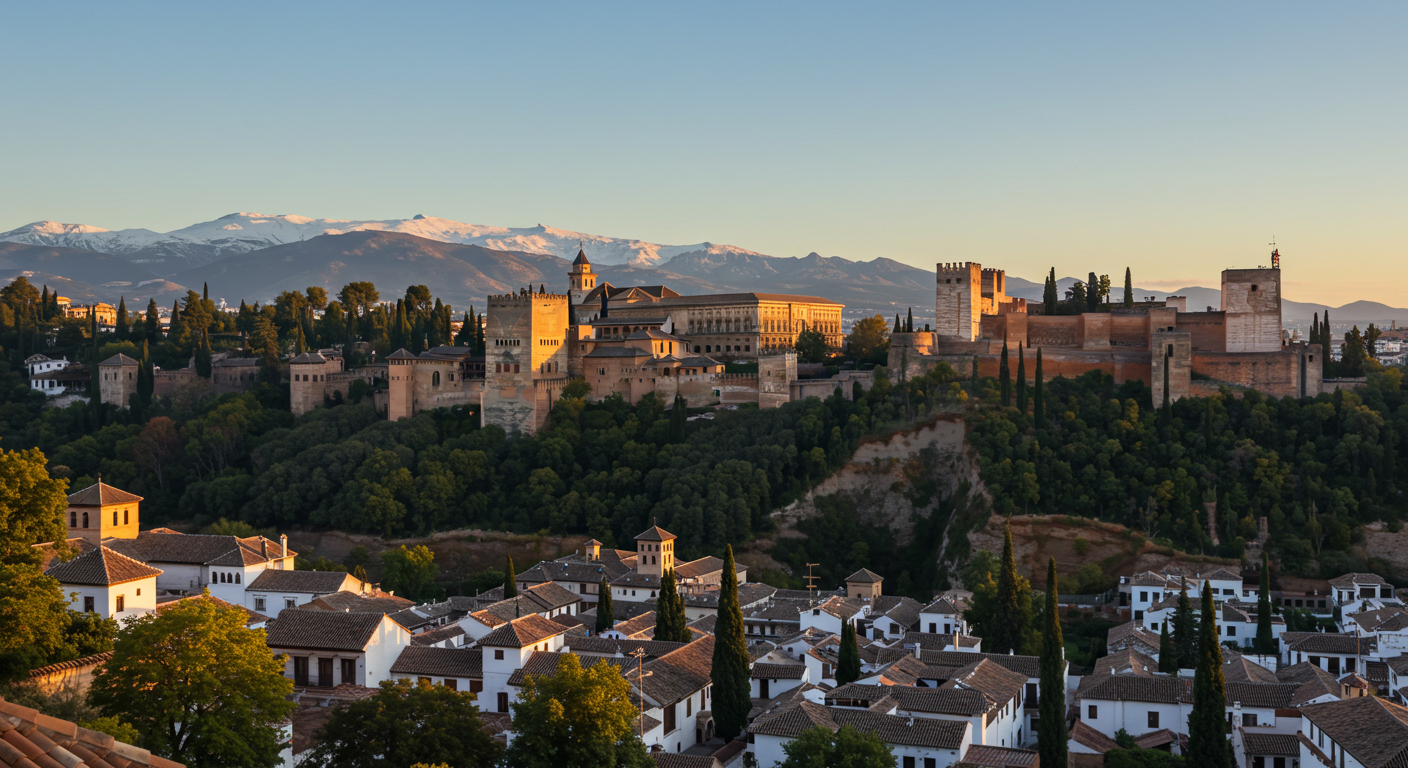
The old Moorish quarter climbs the hill opposite the Alhambra in a tangle of cármenes — walled garden-houses — narrow cobbled lanes, and small squares that appear without warning. It is a UNESCO World Heritage Site, but it functions as a real neighbourhood: there are corner shops, a pharmacy, a primary school. The best way to experience it is simply to walk uphill without a map and see where you end up. The mirador at San Nicolás gives the famous Alhambra view, but arrive at 8am rather than sunset and you will have it almost to yourself.
For slow travellers, the Albaicín is ideal for renting an apartment. A one-bedroom in a traditional carmen with a private terrace costs roughly €900–€1,200 per month as of 2026, though short-term lets via platforms run considerably higher. The neighbourhood has its own microclimate — slightly cooler in summer thanks to elevation and thick walls — and its own pace.
Realejo
Once the Jewish quarter, the Realejo sits below the Alhambra hill on the southern side and is considerably less visited than the Albaicín. It has a relaxed, studenty atmosphere, excellent independent cafés along Calle Santiago, and some of the best tapas bars in the city. Campo del Príncipe is its main square — a large, slightly scruffy space surrounded by traditional bars where the free tapa with every drink is still very much the custom.
Centro and Bib-Rambla
The city centre around the cathedral and Bib-Rambla square is where Granada functions as a proper Andalusian capital. The covered market, the Alcaicería (the old silk market, now selling crafts), and the main shopping streets are all here. It is busier and more tourist-facing than the other neighbourhoods, but it is also where you catch the pulse of ordinary city life: schoolchildren, pensioners playing cards, office workers eating a quick bocadillo at a stand-up bar.
Sacromonte
Above and beyond the Albaicín, Sacromonte is built into the hillside in cave-houses — cuevas — many of which are still inhabited. It is the traditional home of Granada's Roma community and the birthplace of zambra, the local form of flamenco. The neighbourhood has gentrified somewhat, but it retains a genuinely distinct character. Walk up Camino del Sacromonte on a Sunday afternoon and you may find impromptu music drifting from open cave doors.
Zaidín
Few tourists ever reach Zaidín, the working-class residential district south of the centre. That is precisely why it is worth visiting. The market on Calle Doctor Severo Ochoa is where Granadinos actually shop for vegetables and fish. The bars are cheap, the tapas generous, and nobody is performing for an audience.
Eating and Drinking the Granada Way
Granada is one of the last cities in Spain where the free tapa with every drink survives as a serious institution rather than a token gesture. Order a beer or a glass of house wine (typically €2–€2.50 as of 2026) and a small plate arrives — perhaps a slice of tortilla, a dish of fried aubergine with cane honey, a small stew, or a portion of remojón, the local salad of salt cod, orange, and olives. Order a second drink and a different tapa arrives. This is not a gimmick; it is how Granadinos eat lunch.
Where to Eat Well
Bodegas Castañeda (Calle Almireceros) is the most famous traditional bar in the city and deservedly so — barrels of wine behind the counter, marble tables, hanging hams, and a crowd that mixes tourists with regulars who have been coming for decades. Go for the atmosphere as much as the food.
Bar Los Diamantes near the cathedral is the place for fried fish done properly: boquerones, chopitos, gambas. Queue outside if necessary; it moves quickly.
Greens & Berries (Calle Málaga) is a more recent addition, run by a local family and serving genuinely good vegetarian and vegan food — useful to know in a city whose traditional cooking is heavily meat-based.
For a proper sit-down meal, Restaurante Damasqueros in the Realejo has been one of the city's most consistent kitchens for years, offering updated Andalusian cooking — oxtail, berenjenas, slow-cooked lamb — at prices that feel reasonable for the quality (expect €35–€45 per head with wine as of 2026).
The Mercado de San Agustín
The covered market beside the cathedral is the best single place to understand what Granadinos eat. Go on a weekday morning. The fish stalls alone — with their Motril prawns, espetos-ready sardines, and fresh tuna from the Strait — are worth the visit. Stall holders are accustomed to visitors asking questions; most will happily tell you how to cook what they are selling.
Slowing Down with Coffee and Conversation
The tetería — the Moorish tea house — is a Granada institution with no real equivalent elsewhere in Spain. Concentrated in the lower Albaicín around Calle Calderería Nueva, these narrow, cushion-lined rooms serve dozens of varieties of tea alongside pasteles árabes (honey-soaked pastries). They are perfect for a slow afternoon: order a pot of té moruno (mint tea with pine nuts), eat a pastel de dátiles, and read for two hours. Nobody will rush you.
For coffee, the local habit is the café con leche taken standing at the bar, but if you want to sit and linger, the café culture around Plaza de la Trinidad and the university district is genuinely good. Café Fútbol on Plaza de Mariana Pineda has been serving churros and hot chocolate since 1922 and remains one of the best places in the city for a slow breakfast.
Beyond the Alhambra: What to Do With Your Time
Book the Alhambra Properly
The Alhambra requires advance booking — tickets sell out weeks ahead, especially for the Nasrid Palaces, which have timed entry slots. As of 2026, general admission is €18 for adults, with the Generalife gardens included. Book directly through the official Patronato website to avoid reseller markups. The best slot for slow travellers is the first entry of the morning (currently 8:30am) when the light in the Nasrid Palaces is extraordinary and the crowds are thin. Give yourself at least four hours; most people rush through in two and miss half of it.
Walk the Sierra Nevada
Granada is the starting point for some of the best mountain walking in Spain. The Sierra Nevada National Park begins effectively at the city's edge. A bus from the main bus station takes you up to Pradollano (the ski resort) in under an hour; from there, trails lead into genuinely wild high-mountain terrain. The Mulhacén — at 3,479 metres, the highest peak in mainland Spain — is a serious day hike from the Hoya del Portillo refuge, best attempted between June and October. But you do not need to summit anything to enjoy the sierra: the lower valleys around Güéjar Sierra offer beautiful walking through pine forest and along the Genil river, accessible by a narrow-gauge railway from the city.
The Alpujarras
An hour south of Granada by bus, the Alpujarras are a series of white villages clinging to the southern slopes of the Sierra Nevada — Berber in architecture, medieval in pace, and genuinely beautiful. Lanjarón, Órgiva, Pampaneira, Capileira: each has its own character. The GR-7 long-distance trail passes through the region. A slow traveller could spend a week walking between villages, staying in small family-run casas rurales (budget €60–€90 per night as of 2026), eating jamón de Trevélez (cured at altitude and considered among the finest in Spain), and barely seeing another tourist.
Flamenco Without the Tourist Trap
Granada's zambra — performed in the cave venues of Sacromonte — is one of the most commercialised flamenco experiences in Spain, and most of the shows aimed at tourists are, frankly, not worth the €25–€35 entry fee. The exception is the Cueva de la Rocío, which has maintained a reputation for genuine artistry over decades. But for authentic flamenco, the better route is to check the programme at the Centro Cultural Manuel de Falla and the Auditorio Manuel de Falla — both host serious flamenco performances by major artists, often at reasonable ticket prices. The annual Festival Internacional de Música y Danza in June and July brings world-class performers to venues across the city, including outdoor stages in the Alhambra gardens themselves.
Practical Matters for Staying Longer
Cost of Living
Granada is one of the most affordable cities of its size in Spain. As of 2026, a furnished one-bedroom apartment in the centre or Realejo runs €700–€1,000 per month on a medium-term let. Groceries for one person cost roughly €200–€250 per month if you shop at the mercado and local supermarkets (Mercadona has several branches; there is a good Lidl near the bus station). Eating out — given the free-tapa culture — is genuinely cheap: you can have a full lunch of two drinks with tapas for under €6.
Monthly transport is not a pressing concern in the historic centre, which is compact and walkable, though the city bus network is reliable and inexpensive (a ten-trip bonobus card costs around €8 as of 2026).
Connectivity and Working Remotely
Granada has a large, active university and a growing community of remote workers and digital nomads drawn by the low cost of living and quality of life. Fibre broadband is standard in most apartments. Co-working spaces have multiplied in recent years: Coworking Granada near the cathedral and La Mafia in the Realejo are two of the more established options, with day passes around €15–€20 and monthly memberships from €120 as of 2026.
Getting There and Around
Granada's Federico García Lorca airport has limited direct international connections — mainly to London Heathrow (British Airways), Amsterdam, and a handful of other European cities. The more reliable option from the UK is to fly to Málaga (a major hub with dozens of daily flights) and take the direct bus to Granada, which takes about 90 minutes and costs around €14. The train from Madrid takes just under three hours on the high-speed AVE service (from approximately €25 booked in advance).
Within the city, the historic centre is best explored on foot. The C34 minibus navigates the Albaicín's narrow streets and is the easiest way to reach the upper barrio without the climb.
A Note on Timing
Granada has four distinct seasons and all of them are liveable. Spring (March to May) is arguably the finest time: warm days, almond blossom in the Generalife, and the city at its most beautiful before the summer crowds arrive. Summer (July and August) is hot — temperatures regularly exceed 38°C — but evenings are lively and the city does not empty the way coastal resorts do. Autumn brings cooler temperatures, the grape harvest in the surrounding vega, and a return of the university population. Winter is cold by Andalusian standards (occasional frost, snow on the sierra visible from the city) but mild by any other measure, and the Alhambra in December, with thin winter light and almost no queues, is one of the great experiences in Spanish travel.
Granada does not give itself up quickly, and that is the point. The city has been layered over centuries — Roman, Moorish, Christian, Republican, modern — and each layer is still visible if you look slowly enough. Come with time, walk without a plan some mornings, let the tapas accumulate, and the Alhambra will start to feel like a backdrop to your life rather than the reason for your trip. That is when you will understand what Granada actually is.
Frequently asked questions
- How many days do you need in Granada to see it properly?
- Most travellers give Granada two or three days, which is enough to see the Alhambra and the main sights but not enough to understand the city. For a genuinely slow experience — walking the Albaicín without a schedule, day-tripping to the Alpujarras, catching a proper flamenco performance — allow at least five to seven days. A month-long stay transforms it into a base for exploring the wider region.
- Is Granada expensive compared to other Spanish cities?
- Granada is one of the more affordable cities in Spain. As of 2026, rent, food, and daily costs are noticeably lower than in Madrid, Barcelona, Seville, or Málaga. The free-tapa culture means eating and drinking out costs remarkably little. It is an excellent choice for budget travellers and remote workers looking to stretch their money.
- Do I need to book the Alhambra in advance?
- Yes, absolutely. Tickets — especially for the Nasrid Palaces, which have timed entry — sell out weeks ahead during spring and summer. Book directly through the official Patronato de la Alhambra website as early as possible. Avoid third-party resellers, who charge significant markups. As of 2026, general admission including the Generalife is €18 per adult.
- What is the best neighbourhood to stay in for a slow travel experience?
- The Albaicín and the Realejo are both excellent choices. The Albaicín offers the most atmospheric setting — traditional architecture, garden terraces, views of the Alhambra — but involves a lot of uphill walking and some noise from tourist foot traffic. The Realejo is flatter, quieter, and has a more genuinely local feel, with good independent cafés and easy access to the centre.
- Is Granada a good base for hiking?
- Exceptionally so. The Sierra Nevada National Park is accessible from the city in under an hour by bus, offering everything from gentle valley walks to the ascent of Mulhacén, the highest peak in mainland Spain. The Alpujarras villages to the south are ideal for multi-day walking. The season for high-mountain hiking runs roughly June to October.
- Where can I find authentic flamenco in Granada?
- Avoid most of the commercial Sacromonte cave shows aimed at tourists. For genuine performances, check the programme at the Centro Cultural Manuel de Falla and the Auditorio Manuel de Falla. The Festival Internacional de Música y Danza in June and July is one of the best opportunities in the year to see world-class flamenco in extraordinary settings, including outdoor venues within the Alhambra complex.
- What is the best time of year to visit Granada?
- Spring (March to May) is widely considered the finest time — warm, uncrowded, and beautiful. Autumn is also excellent. Summer is hot (regularly above 38°C) but evenings are lively. Winter is cold by Andalusian standards but mild overall, and offers the advantage of very few tourists and extraordinary light at the Alhambra.