Jamón Ibérico vs Serrano: How to Buy the Right Ham in Spain
The real difference between jamón ibérico and serrano explained: grades, labels, prices, and how to buy and eat Spanish ham without getting ripped off.
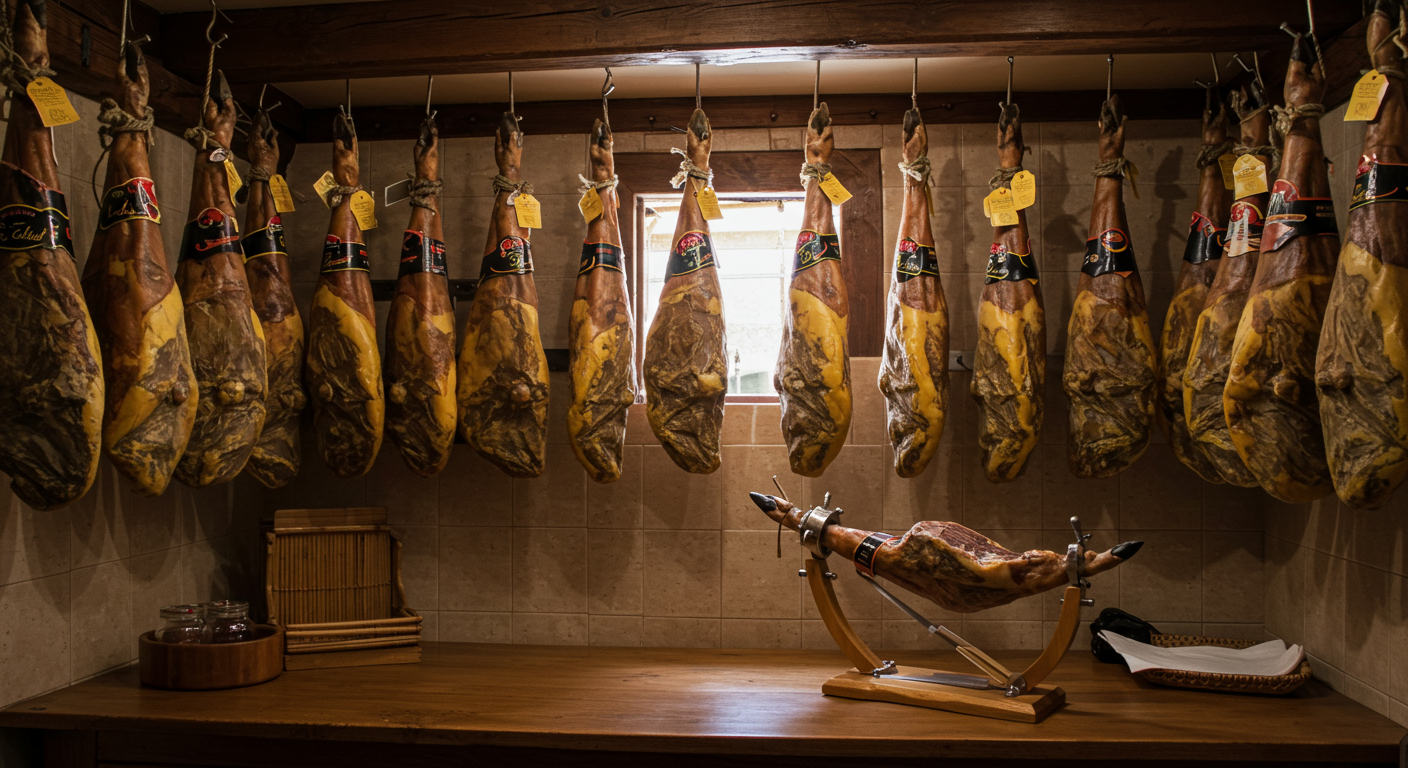
Walk into any Spanish supermarket and the ham section will stop you cold. Whole legs stacked on metal stands, vacuum-packed slices in every price bracket from €2 to €25, labels covered in words like bellota, cebo, 50% raza ibérica, and a colour-coded tag system that looks like it was designed to confuse. It isn't, once you know the rules — but nobody explains them at the point of sale.
The core difference between jamón ibérico and jamón serrano is this: ibérico comes from Iberian-breed pigs (or crossbreeds), while serrano is a catch-all term for cured mountain ham from white-breed pigs. Ibérico is almost always better, almost always pricier, and has a legally defined four-tier grading system based on breed purity and diet. Serrano has no such system — quality varies wildly. If you're buying a leg to take home or ordering a plate in a bar, knowing which label to look for will save you real money and stop you overpaying for something mediocre.
Jamón Serrano: What You're Actually Getting
Serrano means "from the sierra" — mountain-cured. The pigs are white breeds: Duroc, Landrace, Large White. The hams are salted, dried, and aged, usually for somewhere between seven months and two years depending on the producer. A Gran Reserva serrano has been aged at least fifteen months and is genuinely good eating. A basic serrano aged eight or nine months is fine on a bocadillo but not something you'd put on a board for guests.
There's a TSG (Traditional Speciality Guaranteed) designation for jamón serrano, which at least tells you it was made using traditional methods, but it doesn't guarantee any particular quality level. The honest truth is that the best serrano — a proper Gran Reserva from somewhere like Teruel or Trevélez — is excellent value and easily underrated. Teruel, in Aragón, has its own DO (Denominación de Origen) and produces hams that are leaner, pinker, and subtler than ibérico. Worth seeking out, and usually €30–50 cheaper per leg.
What you should avoid: the generic supermarket serrano with no provenance information, sold in a plastic tray for €1.80 per 100g. It'll be rubbery, salty, and forgettable.
Jamón Ibérico: The Four Grades Explained
Spain introduced a standardised colour-coded label system in 2014 specifically to end consumer confusion in the ibérico category. Four grades, four tag colours. This is the system that actually matters.
Black label — Jamón Ibérico de Bellota 100% Ibérico. This is the top. The pig is 100% Iberian breed, raised free-range in the dehesa (the cork oak and holm oak woodland of Extremadura and Andalusia), and fattened exclusively on acorns (bellotas) and natural pasture during the montanera — the autumn and winter season when the oaks drop their fruit. These hams are cured for a minimum of 36 months, often 48. The fat is deeply marbled, silky, almost liquid at room temperature. It tastes of something. Price for a whole leg: anywhere from €400 to well over €1,000 for a top producer like Cinco Jotas or Joselito. Per 100g of sliced, budget €15–30 in a good shop.
Red label — Jamón Ibérico de Bellota (50% or 75% Ibérico). Same acorn-fed, free-range conditions, but the pig is a crossbreed: typically an Iberian mother and a Duroc father, making it 50% Iberian. Quality is still very high. The fat doesn't marble quite the same way, but to most palates the difference is subtle. This is what most tapas bars serve when they say jamón ibérico de bellota. A whole leg runs roughly €150–350.
Green label — Jamón Ibérico de Cebo de Campo. Iberian breed (50–100%), raised partly outdoors with access to pasture, but fed a combination of natural forage and commercial feed — no strict bellota diet. Cured at least 24 months. Decent ham. Noticeably less complex than bellota. Good for everyday eating at home.
White label — Jamón Ibérico de Cebo. Iberian breed pigs raised entirely indoors on commercial feed. The least of the ibérico range, though still technically ibérico. Often sold in supermarkets at a price that looks like a deal on bellota — it isn't. Read the label.
The single most important thing: always check for the coloured tag on a whole leg, or the grade stated clearly on packaged slices. If a restaurant menu just says jamón ibérico with no grade, ask. They should know. If they don't, assume it's white or green label.
Where the Best Ibérico Comes From
The four main DO zones are Jabugo (Huelva, Andalusia), Dehesa de Extremadura, Guijuelo (Salamanca, Castile and León), and Los Pedroches (Córdoba, Andalusia). Jabugo is the most famous — Cinco Jotas is based there — and commands the highest prices partly on reputation. Guijuelo hams tend to be slightly milder and less fatty. Extremadura hams are often more intensely flavoured. None of them are bad. The DO matters less than the producer and the grade.
Jabugo the village is worth a visit if you're in the Sierra de Aracena in Huelva — the whole area smells of curing ham and the local bars serve it at source prices. It's one of those places where you eat something and recalibrate your expectations entirely.
How to Buy Jamón in Spain Without Getting Ripped Off
For sliced ham to eat at home or take as a gift, a specialist jamonería will always beat a tourist-area deli on quality and usually on price. In Madrid, look around Mercado de San Miguel's surrounding streets rather than inside the market itself — inside is theatre for tourists. Calle Ponzano has several good options. In Barcelona, the Mercat de l'Abaceria in Gràcia or any decent charcutería in the Eixample will serve you better than anything on Las Ramblas.
For vacuum-packed slices to take home, El Corte Inglés's food hall is genuinely reliable — the grade is always clearly marked, the turnover is high so it's fresh, and the range is wide. Mercadona sells a reasonable 50% ibérico de cebo that's honest value at around €3–4 per 100g (as of 2026). Don't expect bellota from a supermarket at that price; it doesn't exist.
If you want to bring a whole leg back to the UK or elsewhere, check import rules carefully — cured whole hams in their original packaging are generally allowed into the UK post-Brexit, but it's worth confirming current APHA guidance before you travel. A whole black-label leg will not fit in a standard suitcase without planning.
Buying a Whole Leg: What to Know
A whole leg (pata negra is the colloquial term, though technically it refers to the black hoof of the Iberian pig) needs a jamonero — a ham stand — and a long, flexible knife. If you're living in Spain and this is going to be a regular thing, the €30–50 investment in a decent stand is worth it. Buying a whole leg works out significantly cheaper per kilo than buying slices, but you need to commit to eating through it steadily — once cut, the exposed surface should be covered with the outer fat or a clean cloth and kept at room temperature, not in the fridge.
For anyone who's recently moved to Spain and is still sorting the practical stuff — renting a place, getting a bank account set up, working out the healthcare situation — a whole leg feels like a premature domestic commitment. Buy slices until you're settled.
How to Eat It Properly
Room temperature. Always. Cold ham tastes of nothing. If you've bought a pack from the fridge, let it sit out for 20–30 minutes before eating. The fat needs to soften and the aromas need to open up.
Slice it thin — almost translucent for bellota. The traditional way is hand-carved (cortado a cuchillo), and it genuinely does taste different from machine-sliced because the knife follows the grain and the fat distributes differently. Most good jamonerías will carve to order.
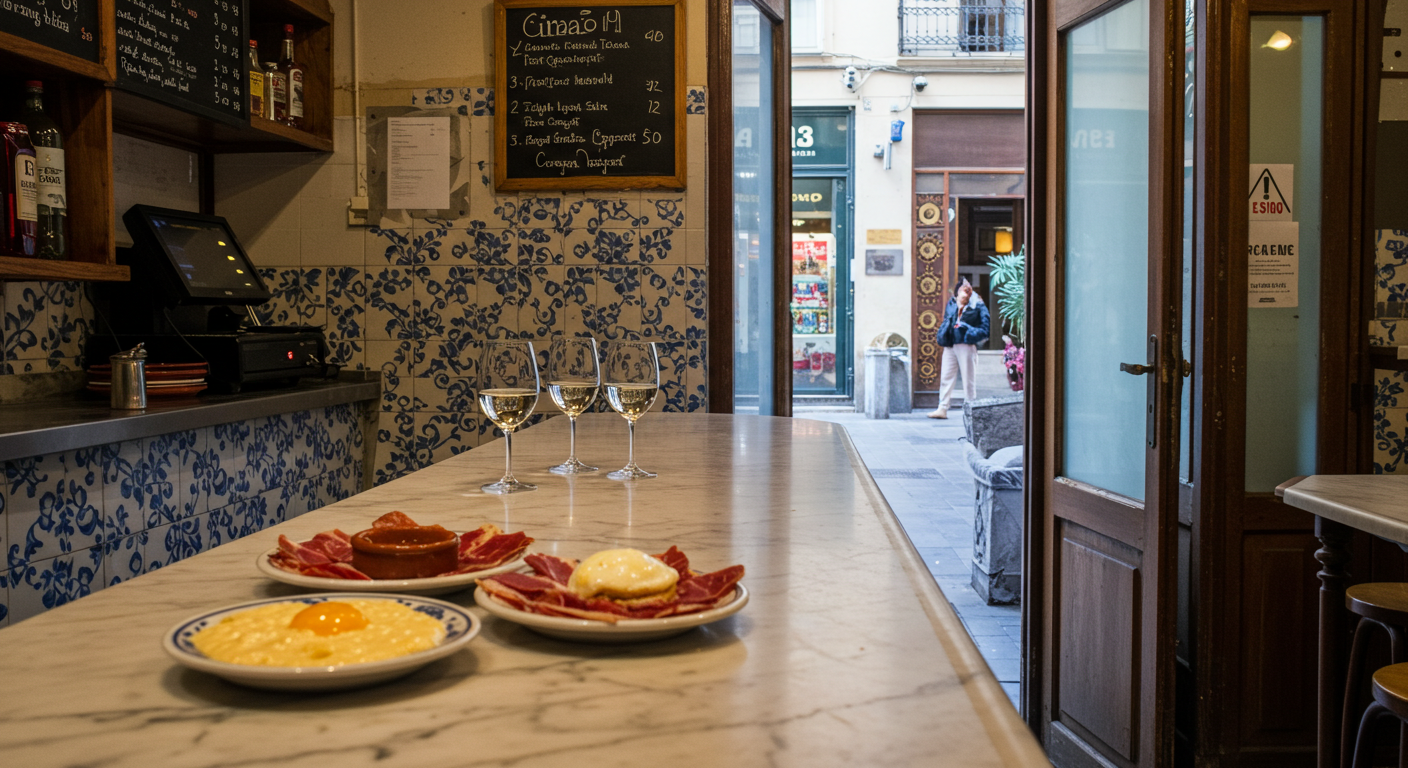
Serve it simply. Good bread, maybe a little tomato rubbed on it in the Catalan style (pa amb tomàquet), perhaps a glass of fino sherry or a young Rioja. Don't serve it with anything strong enough to compete with the flavour. No pickles alongside a black-label slice — that's a waste.
In a restaurant, if you order a ración of jamón ibérico de bellota and it arrives cold and machine-sliced, you're either in the wrong restaurant or paying too much for what you're getting. A proper plate should be hand-carved or at least allowed to come to temperature before serving. Some places are better than others about this; it's a reasonable thing to ask about before ordering.
The Price Reality Check
To give you a rough frame as of 2026: 100g of decent 50% ibérico bellota in a good Madrid jamonería runs about €8–14. Black-label 100% ibérico bellota from a top producer, hand-carved, can be €20–35 per 100g. A mid-range serrano Gran Reserva in slices is €3–6 per 100g. These are shop prices; restaurant markups are significant.
The sweet spot for everyday quality-to-price is the red-label 50% ibérico bellota. It's widely available, genuinely delicious, and won't make you wince at the bill. Save the black label for a proper occasion — or for when you've been here long enough to have a jamonero on the kitchen counter and a reason to open something serious.
Spain has a way of making you recalibrate what food is worth spending money on. A €12 plate of properly carved bellota with a glass of wine in a bar in Seville or a side street in Madrid is one of the better value experiences the country offers. Once you know what you're ordering, you'll stop guessing and start choosing.
Frequently asked questions
- What is the real difference between jamón ibérico and jamón serrano?
- Jamón ibérico comes from Iberian-breed pigs (or crossbreeds) and has a legally defined four-tier quality system based on breed purity and diet. Jamón serrano is a broader category covering cured ham from white-breed pigs with no equivalent grading system. Ibérico is generally richer, more complex, and more expensive; the best serrano (such as Teruel DO or Trevélez) is excellent but more subtle.
- What do the coloured labels on jamón ibérico mean?
- Spain's four-colour label system: black = 100% Iberian breed, acorn-fed, free-range (the best); red = 50–75% Iberian breed, acorn-fed, free-range; green = Iberian breed, partly outdoor-raised, mixed diet; white = Iberian breed, indoor-raised on commercial feed. Always check the label or tag — the colour tells you the grade.
- Is pata negra the same as jamón ibérico de bellota?
- Not exactly. 'Pata negra' (black hoof) is a colloquial term that refers to the black hoof of Iberian-breed pigs and is often used loosely to mean top-quality ibérico ham. Legally, it has no specific definition — the official quality grades are determined by the coloured label system. Don't buy based on a 'pata negra' claim alone; check the actual grade.
- Can I bring Spanish jamón back to the UK?
- Whole cured hams in their original sealed commercial packaging are generally permitted into the UK, but rules can change. Check current APHA (Animal and Plant Health Agency) guidance before you travel. Homemade or loosely wrapped ham is a different matter and should not be brought across the border.
- Where is the best place to buy jamón in Spain?
- A specialist jamonería will give you the best quality and advice. In Madrid, try shops in streets around Calle Ponzano or Chamberí rather than tourist-area delis. In Barcelona, look in Gràcia or the Eixample. For reliable packaged slices, El Corte Inglés food halls are consistently good. Avoid tourist-area stalls near major monuments — the markup is high and provenance is often unclear.
- How should jamón be stored once opened?
- Sliced packaged jamón should be refrigerated and eaten within a day or two of opening. A whole cut leg should be stored at room temperature — not in the fridge — with the exposed cut surface covered by its own outer fat or a clean cloth. Never wrap a cut leg in cling film; it needs to breathe.
- What wine or drink goes best with jamón ibérico de bellota?
- Fino or manzanilla sherry is the classic pairing — the dry, saline character of the wine cuts through the fat beautifully. A young, unoaked Rioja or a Ribera del Duero also works well. Cava is a reasonable choice for a celebration. What doesn't work: heavily tannic or oaked reds that overpower the subtle flavour of a good bellota.