A Slow Guide to Bilbao: Guggenheim, Casco Viejo and Pintxos Crawls
How to spend 3 days in Bilbao doing pintxos crawls, the Guggenheim and the Casco Viejo properly — without rushing or eating badly.
Three days in Bilbao is enough — just. Any less and you're skimming; any more and the city starts to reveal how small it actually is, which is not a criticism. Bilbao is compact, walkable, and so thoroughly itself that it rewards a slower pace more than almost anywhere else in Spain.
If you're planning how to spend 3 days in Bilbao between the Guggenheim, the Casco Viejo and pintxos crawls, here's the direct version: base yourself in Abando or the Ensanche (the newer grid district), give the Guggenheim one long morning, spend your afternoons in the old town eating and drinking your way through the streets around Plaza Nueva, and do not rush any of it. The pintxos are the point. The Guggenheim is the punctuation.
Now the longer version, because the short version leaves out everything useful.
Why Bilbao Is Worth Three Slow Days
Bilbao gets written off by people who spent 36 hours there, ticked the Guggenheim, and caught a train to San Sebastián. That's a shame, though I understand it — the Basque Country is full of places that feel urgent. Donostia pulls hard. But Bilbao has its own atmosphere, one that's more industrial, more working-class in the best sense, and honestly less precious about itself than its coast-dwelling neighbour.
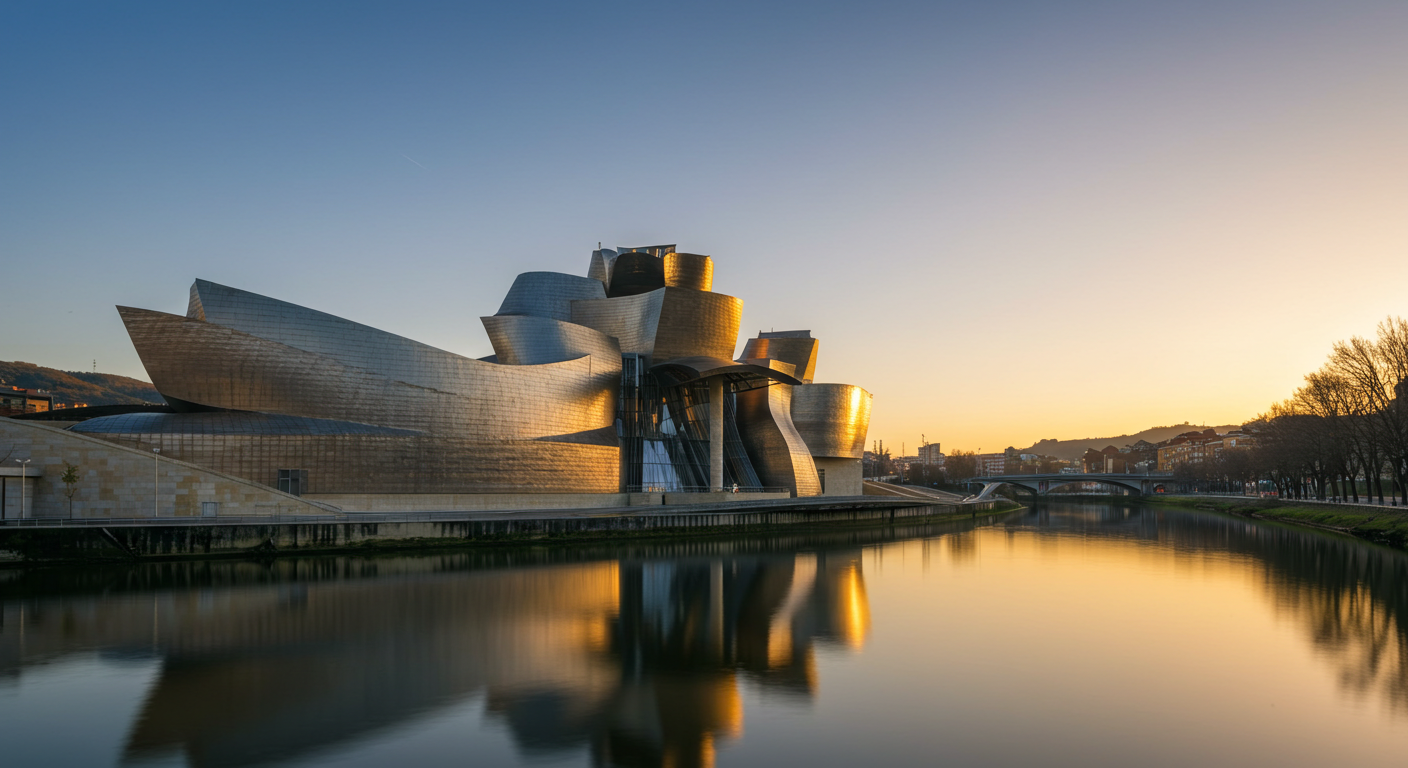
The Nervión river still runs through the city the way a working river should: a bit grey, flanked by regenerated waterfront and old cranes, with the Guggenheim sitting at a bend that looks almost too good to be accidental. (It wasn't — Frank Gehry and the city's urban planners spent years on that placement.) The Casco Viejo, or Zazpikaleak, is the seven original streets of the medieval city, now a warren of pintxos bars, independent shops, and neighbourhood bakeries that open at 7am for people who actually live there.
This is a city you can walk from end to end in forty minutes. Use that.
Day One: The Guggenheim and the Waterfront
Go to the Guggenheim in the morning. This is not negotiable. By midday the atrium fills up and the light changes. The titanium exterior is at its best before 11am when the sun hits it at a low angle and the whole building seems to shift colour as you walk around it. Budget two hours minimum inside — longer if the temporary exhibition is worth it (check what's on at guggenheim-bilbao.eus before you go, because the permanent collection is good but the temporary shows are often exceptional).
Tickets as of 2026 are around €18 for adults, with free entry on some Sunday afternoons — check the exact dates on the website. There's a restaurant inside, but skip it for lunch. Walk instead along the Abandoibarra waterfront toward the Euskalduna conference centre, then cross the Zubizuri footbridge (the white one by Santiago Calatrava — it's slippery when wet, which in Bilbao is often). Lunch at one of the bars along Calle Ledesma: this street is slightly off the tourist circuit and better for it.
The afternoon is for the Museo de Bellas Artes, five minutes' walk from the Guggenheim through Doña Casilda park. It's free on Wednesdays and undervisited every other day. The collection runs from Flemish masters to Basque painters from the late 19th century, and there's a room of Ignacio Zuloaga portraits that will stop you in your tracks. It doesn't try to compete with its famous neighbour. It doesn't need to.
Evening: your first real pintxos crawl. Stick to the Ensanche tonight — Calle Ledesma and the streets around it. Berton (on Jardines) is reliable and busy for a reason. Two or three pintxos and a small glass of txakoli per bar, then move. This is the rhythm.
Day Two: The Casco Viejo, Properly
The Casco Viejo is best on a weekday morning before the tour groups arrive, but it's worth it any day if you're early. Start at the Mercado de la Ribera on the riverbank — the largest covered market in the Basque Country, according to the city, though I'd verify that rather than take it as gospel. What's undeniable is that it's beautiful inside: an art deco building on three levels, with fishmongers, cheese stalls, and a pintxos bar on the ground floor that opens at 8am.
Buy something. An idiazabal cheese from one of the Navarran stalls. A small bag of dried peppers. Something you'll eat later.
Then walk the Siete Calles — the seven streets. They're genuinely medieval in layout if not in building fabric, and on a weekday morning they smell of coffee and fresh bread in a way that feels like a cliché until it happens to you. The Catedral de Santiago is worth a few minutes; it's quieter and more human in scale than you'd expect.
For lunch on day two: El Globo on Calle Diputación is one of the best pintxos bars in the city and gets overlooked because it's in the Ensanche rather than the Casco Viejo. The gilda (the classic Basque skewer of olive, anchovy and guindilla pepper) here is as good as any I've had, including in San Sebastián — and I say that knowing it's a comparison that will irritate people.
Speak of which: if you're planning to compare the two cities' food cultures, read our guide to eating in San Sebastián first. They're different beasts.
Afternoon on day two: take the Artxanda funicular up the hill above the city. It costs a few euros, runs every fifteen minutes, and the view from the top explains Bilbao's geography better than any map. You can see how the river carved the valley, why the city grew the way it did, and — on a clear day — a strip of green hills that reminds you you're in the wettest corner of Spain. There's a restaurant at the top, but have a drink and come back down for dinner.
Day Three: Neighbourhoods You Weren't Planning to Visit
Most three-day itineraries stop after the Guggenheim and the Casco Viejo. Day three is where slow travel actually starts.
San Francisco and Bilbao La Vieja, just across the river from the Casco Viejo, were the city's roughest neighbourhoods for decades and have spent the last fifteen years becoming something more interesting: immigrant-run restaurants, small galleries, a ceramic studio that does drop-in classes, bars that don't cater to anyone who arrived last weekend. It's still unpolished. That's the point.
For breakfast: any of the small Moroccan or South American cafés along Calle San Francisco. For mid-morning: the Azkuna Zentroa, a Philippe Starck-designed cultural centre inside a converted wine warehouse in the Ensanche. The interior is absurd in the best possible way — 43 columns each decorated differently, a transparent-floored swimming pool above the main hall, a cinema, a library, and a café where you can sit for an hour and nobody will move you on.
Lunch on day three should be a proper sit-down meal. Mina, on the riverbank near the Casco Viejo, has a tasting menu that runs around €80–100 per person as of 2026 — it's a Michelin-starred restaurant and worth it if food is why you travel. If that's too much, Café Iruña near the Arriaga theatre is a grand old Moorish-tiled café-restaurant where you can eat a decent menú del día for around €14–16 and feel like you're in 1920s Bilbao, which in some ways you are.
The Pintxos Crawl: A Practical Note
Pintxos crawls work on a simple principle: small plates, standing up, one bar at a time, no lingering. But there are a few things nobody mentions.
First: the best pintxos in Bilbao are not always the ones on the bar top. Some bars keep their hot pintxos in the kitchen and you have to ask — or watch what the locals are ordering and point. The word is caliente if you want the hot ones.
Second: txakoli is the local white wine, slightly sparkling, poured from a height to aerate it. It's sharp and dry and perfect with seafood pintxos. A glass is typically €2.50–3.50. Don't let anyone upsell you to something fancier on a pintxos crawl.
Third: Thursday evenings are quietly the best time. The bars fill up with locals after work, the atmosphere is relaxed, and you're not competing with a hen party from Bristol for bar space. (No offence to Bristol.)
A workable route in the Casco Viejo: start at Bar Bilbao on Plaza Nueva (the house vermouth is good), move to Gatz on Calle Santa María (famous for its mini-burger pintxo, which sounds gimmicky but isn't), then to Baster on the same street for the bacalao pintxos, and finish at El Txoko Berria on Calle Belosticalle, which stays open late and has a txakoli list longer than some wine bars.
Getting There and Getting Around
Bilbao's airport (BIO) is small and efficient. Vueling, Iberia and Ryanair all serve it from various UK airports, with flight times around two hours. The bus into the city (the Bizkaibus A3247) takes about 25 minutes to the Termibus station and costs around €3 as of 2026. A taxi is €25–35 depending on traffic.
The metro is clean, runs on time, and was designed by Norman Foster — which you'll notice immediately. A single journey is around €1.80. The tram (Euskotran) connects the Casco Viejo to the Guggenheim waterfront and the Ensanche, and is worth using at least once just because it's pleasant.
If you're considering a longer stay in the Basque Country — or thinking about relocating — the bureaucratic groundwork is the same as anywhere in Spain. You'll need your NIE sorted early; the step-by-step guide to NIE and TIE is the clearest overview of what to expect. And if you're arriving with family, the logistics of moving to Spain with children and pets are worth reading well in advance.
Where to Stay
The Ensanche (Abando district) is the most practical base: central, well-connected, and full of neighbourhood bars that aren't aimed at visitors. A decent mid-range hotel here runs €90–130 per night in 2026, more in July and August when the city fills up for summer events. The Gran Vía is the main artery — staying within a few streets of it puts everything within walking distance.
The Casco Viejo has more character but is noisier on weekend nights. If you're a light sleeper, ask for a room facing a courtyard rather than the street.
Avoid the area immediately around the Guggenheim for accommodation — there's not much there and it's oddly disconnected from the rest of the city on foot.
Bilbao in slow travel terms is a city that gives more the less you rush it. Three days done properly — one long museum morning, two afternoons in old streets, several evenings eating standing up with a glass of txakoli — leaves you with a clearer sense of the Basque Country than any highlight reel could. Go in spring or early autumn if you can. The light is better and the rain, when it comes, is the kind you can walk in.
Frequently asked questions
- How many days do you need in Bilbao to see the Guggenheim and the Casco Viejo?
- Three days is the sweet spot. One morning covers the Guggenheim properly, one day handles the Casco Viejo and the Ribera market, and a third day lets you explore the neighbourhoods — like Bilbao La Vieja and the Azkuna Zentroa — that most short visits miss entirely.
- What is the best area to stay in Bilbao for a first visit?
- The Ensanche (Abando district), within a few streets of the Gran Vía. It's central, walkable to everything, and has a good mix of local bars and restaurants that aren't geared exclusively toward tourists. Mid-range hotels here run roughly €90–130 per night as of 2026.
- When is the best time to do a pintxos crawl in Bilbao?
- Thursday evenings are quietly ideal — the bars fill with locals after work, the atmosphere is relaxed, and it's less crowded than weekends. Weekday lunchtimes (1–3pm) also work well. Avoid Saturday nights in the Casco Viejo in high summer unless you enjoy queuing.
- Is Bilbao or San Sebastián better for pintxos?
- They're different rather than one being better. San Sebastián (Donostia) has more elaborate, almost competitive pintxos culture with higher prices to match. Bilbao is earthier and slightly cheaper, with a stronger tradition of simple, perfectly-made classics like the gilda and bacalao pintxos. Ideally, visit both.
- How do you get from Bilbao airport to the city centre?
- The Bizkaibus A3247 is the cheapest option — around €3 as of 2026, taking roughly 25 minutes to the Termibus station. Taxis cost €25–35. There's no train or metro directly from the airport.
- Is the Guggenheim Bilbao free on Sundays?
- There are free Sunday afternoon slots, but they're limited and the specific times change — check the official Guggenheim Bilbao website (guggenheim-bilbao.eus) before you visit. The standard adult ticket is around €18 as of 2026.
- What is txakoli wine and where should you drink it in Bilbao?
- Txakoli (pronounced roughly 'chak-oh-lee') is the local Basque white wine — slightly sparkling, quite dry, and low in alcohol. It's poured from a height to give it a light fizz. In Bilbao's pintxos bars a glass costs around €2.50–3.50. Drink it with seafood pintxos, ideally standing at a bar in the Casco Viejo.