Best Quiet Beaches in Spain for Summer 2026
The best quiet beaches in Spain for summer 2026 — from Galicia's wild coves to secret Balearic bays. Real picks, honest crowds intel, and how to time it right.
August on the Costa del Sol is a special kind of purgatory. Towels touching towels, €6 bottles of water, queues for the loo. Spain has over 8,000 kilometres of coastline and thousands of named beaches — so why does everyone pile onto the same fifty strips of sand?
The best quiet beaches in Spain for summer 2026 are not on the Costa del Sol. They're in Galicia, on the less-visited corners of the Balearics, tucked into the Cabo de Gata, and scattered across the Canaries in places that don't have an easyJet route. The direct answer: if you want genuinely uncrowded sand in July or August, target Galicia's rías, the south coast of Menorca, the Níjar coast in Almería, or Lanzarote's Papagayo area on a weekday morning. Arrive early, avoid the last two weeks of August entirely if you can, and avoid anywhere with a chiringuito that has its own Instagram account.
Below is my coast-by-coast breakdown, based on years of actually going to these places.
Galicia: The Overlooked Atlantic Coast
Most British visitors have no idea how good Galicia's beaches are. The water is cold — 18–20°C in July, sometimes less — but the sand is extraordinary: white, fine, backed by dunes or pine forest, and the crowds are a fraction of the south. The Galicians themselves use these beaches heavily in summer, but the foreign tourist presence is minimal.
Praia de Rodas, on the Cíes Islands off Vigo, has repeatedly been called one of Europe's best beaches, and that reputation has made it busier than it used to be. The islands are a national park; you need to book a ferry from Vigo in advance (through the official Naviera Mar de Ons website, as of 2026 the booking opens in March) and numbers are capped. The cap is the point — it's deliberately quiet. Go on a Tuesday in late June before the school holidays end.
Praia de Carnota is the longest beach in Galicia at around 7km, near the town of Carnota in A Coruña province. On a sunny August weekend the central stretch fills up, but walk fifteen minutes north towards the Pindo estuary and you'll find almost nobody. The hórreos (stone granaries) in the village behind are worth a look.
As Catedrais — properly called Praia de Augas Santas — near Ribadeo is famous for its rock arches. Too famous, now. Skip it in July and August unless you book a timed-entry slot (required since 2015, still in place for 2026). Go in May or September instead.
For accommodation in Galicia, the paradores system is excellent here — the Parador de Baiona is genuinely special — but rural casas de aldea dotted around the rías are much cheaper and often nicer for a week.
Andalusia: Skip the Costa del Sol, Head to Almería
The Costa del Sol is a write-off in August. Torremolinos, Marbella, Nerja — all heaving. The one Andalusian coast worth seeking out in summer is the Parque Natural Cabo de Gata-Níjar, east of Almería city. It's a protected natural park, which means no hotel towers, no development, and actual peace.
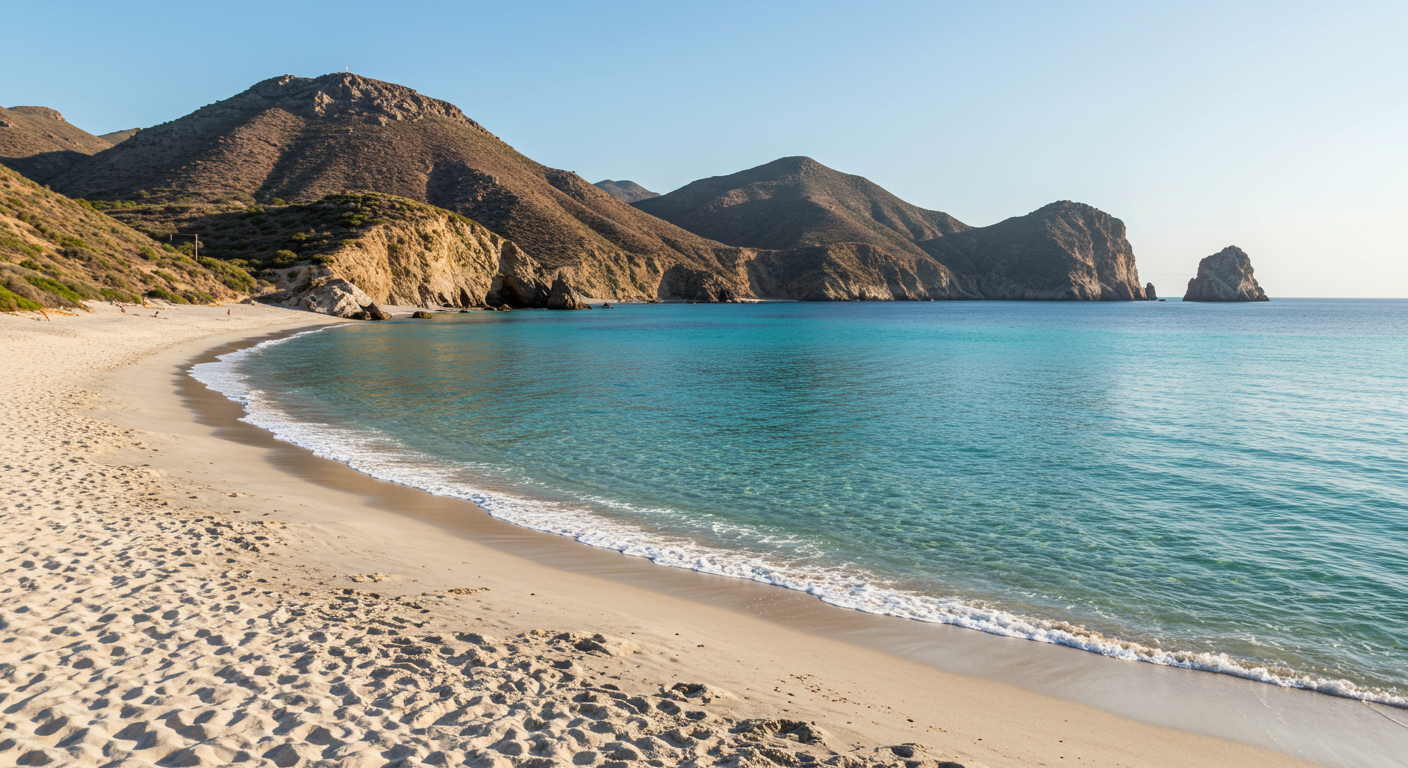
Playa de los Genoveses is the showpiece: a long arc of pale sand backed by volcanic hills, no facilities beyond a car park (which fills by 9am in August — genuinely, arrive at 8 or you're walking 2km). No chiringuito, which puts off a certain type of visitor. Bring everything you need.
Cala de Enmedio near Agua Amarga requires a 30-minute walk from the village, which is exactly what keeps it quiet. The water is clear green-blue and the bottom is sandy rather than rocky. Agua Amarga itself is a tiny village with a few good restaurants — Casa Miguel on the main beach is honest and unpretentious, not cheap (a meal for two will run €50–70 with wine) but the fish is fresh.
Playa de Monsul is the one with the famous lava rock formation. Stunning in the geological sense, slightly awkward for swimming. Worth a visit but not a full beach day.
Almería city is underrated as a base and the AVE now connects it to Madrid in around 2 hours 20 minutes, which makes the journey manageable. It's also one of Spain's cheaper provincial capitals.
The Balearics: Menorca Over Mallorca
Mallorca in August is Ibiza without the music — just as crowded, slightly less chaotic. If you're fixed on the Balearics, Menorca is the saner choice, and the south coast is where the best beaches are.
Cala Macarella and Cala Macarelleta are the obvious picks and, yes, they're busy by 11am in July. The trick is to walk the Camí de Cavalls (the old coastal path that rings the entire island) to smaller coves in between. Cala Turqueta and Cala en Turqueta — same cove, two names — requires a 20-minute walk from a paid car park (around €6–8/day as of 2026); most people don't bother and it shows.
Cala Pregonda in the north of Menorca has reddish sand and bizarre rock formations. It's a 40-minute walk from the nearest parking at Binimel·là. That walk filters out roughly 80% of potential visitors. It's worth every step.
Formentera is technically its own island (a short ferry from Ibiza) and its beaches — particularly Playa de ses Illetes — have water that genuinely looks Caribbean. But word has spread. High season is brutal. Go in June or September.
Ibiza has good beaches north of the tourist strip. Cala d'en Serra is accessible only by a rough track and most car hire companies technically prohibit it. Cala Xuclar near Portinatx is small and usually half-empty even in August. But honestly, if peace is your priority, Ibiza is not your island.
The Canary Islands: Year-Round, and Better Than You Think
The Canaries work in summer precisely because most northern Europeans associate them with winter sun breaks. The German and British mass-market package crowd peaks October to March. July and August are actually quieter by Canarian standards, and the trade winds keep the heat manageable (Lanzarote and Fuerteventura sit around 25–28°C in July, not the 40°C you get inland on the peninsula).
Playa de Papagayo, Lanzarote: a protected natural area south of Playa Blanca with a cluster of small coves. Entry to the park costs around €3 per car as of 2026. The coves closest to the car park fill up; walk further south and the crowds thin dramatically. The water is warm (22–23°C in summer) and incredibly clear.
Cofete, Fuerteventura: this is the wild one. A vast, near-deserted beach on the Jandía peninsula, backed by mountains, accessible via a rough dirt track that takes 45 minutes from Morro Jable. The sea here is rough and swimming can be dangerous — there's a reason there's no development. But the scale and drama of it are unlike anything else in Spain. Worth the trip even if you just walk and don't swim.
Playa de las Teresitas, Tenerife: technically this is a town beach (it's the main beach for Santa Cruz de Tenerife, where the ferries go). The sand was imported from the Sahara in the 1970s. It's calm, sheltered, and used mainly by locals. Surprisingly manageable even in August.
Gran Canaria is more crowded than Lanzarote or Fuerteventura but Playa de Güigüí in the west — a 3-hour hike or a boat from Puerto de Mogán — is one of the most isolated beaches in the Canaries. No facilities, no shade, bring lots of water, and check the boat schedule carefully because missing the last one back is a real possibility.
Catalonia: The Beaches Worth Taking the Train To
Barcelona's city beaches (Barceloneta, Nova Icaria) are convenient but unpleasant in summer — hot, crowded, and prone to petty theft. The Costa Brava north of the city is the answer.
Cala Pola and Cala Bona near Tossa de Mar are small rocky coves that fill fast but clear out by 6pm when the day-trippers leave. Tossa itself is worth an evening — the medieval walled old town is genuinely impressive and the restaurants on the main beach strip are decent without being exorbitant.
Cala Estreta near Palamós requires a 25-minute walk from the car park at Cala Canyelles Petites. Clear water, pine trees right to the edge, a handful of boats usually anchored offshore. One of the better Costa Brava spots.
The southern Costa Daurada has the Delta de l'Ebre, which is less about beaches and more about a vast wetland landscape. La Platja dels Eucaliptus here is flat, long, and almost always quiet — it's the kind of beach that appeals to people who don't want to be entertained.
Practical Notes for Summer 2026
A few things that apply across all of these:
Parking is the pinch point everywhere. Natural park beaches increasingly charge for parking or have capacity limits — budget €5–10/day and check the park's official website before you go, because the rules change year to year.
The last two weeks of August (roughly 13th–31st) are when Spanish domestic tourism peaks. School holidays end in early September in most regions. If you can shift your trip to late August/early September, you'll find the same beaches with 40% fewer people.
Early arrival genuinely works. 8am at Genoveses or Papagayo means you get a spot. 11am means you might not.
If you're planning a longer stay — renting a place near the coast rather than hotel-hopping — the rental market in coastal towns has tightened considerably. Renting in Spain Without a Spanish Payslip: How Foreigners Do It covers the practical side of how foreigners secure leases here. And if you're thinking about relocating more permanently and working remotely from the coast, the Spanish Digital Nomad Visa on Minimum Salary: Is It Worth It? piece is worth reading before you make assumptions about eligibility.
For those already living in Spain and sorting out the admin that comes with it — getting a bank account sorted before a beach-base summer, for instance — Open a Spanish Bank Account as a Non-Resident in 2026 is the practical starting point. And if you're in the middle of residency paperwork while planning your summer, Healthcare in Spain Before Your TIE Arrives: What Cover Do You Actually Have? is worth a read, because the gap between arrival and card-in-hand can be longer than expected.
The one genuinely underrated option I'd push in 2026: the Basque coast. Playa de Laga in the Urdaibai Biosphere Reserve, Sopelana near Bilbao, and the coves around Zumaia with their flysch rock formations are all excellent and barely on the radar of non-Spanish visitors. The water is Atlantic-cold, but so is Galicia's and nobody complains once they're in.
Frequently asked questions
- Which Spanish coast has the quietest beaches in summer 2026?
- Galicia on the Atlantic northwest and the Almería coast (Cabo de Gata) consistently have the fewest foreign tourists in summer. Galicia's beaches are cold but uncrowded and beautiful. Cabo de Gata is warm and protected as a natural park, which limits development and crowds.
- When is the best time to visit Spanish beaches to avoid crowds?
- Late June (after the 20th) before Spanish school holidays begin, or the first two weeks of September after they end, are the sweet spots. July is manageable if you go early in the morning. Avoid 13–31 August entirely if possible — that's when domestic tourism peaks across every coast.
- Are the Canary Islands beaches good in summer?
- Yes, and often less crowded than you'd expect, since the Canaries are seen as a winter destination by most northern Europeans. July and August temperatures in Lanzarote and Fuerteventura are around 25–28°C with trade winds keeping it bearable. Papagayo (Lanzarote) and Cofete (Fuerteventura) are the standout beaches.
- Is Menorca better than Mallorca for beaches?
- For quiet beaches, yes. Menorca is smaller, less developed, and its south coast has a series of coves — Macarella, Turqueta, Pregonda — that require walks from car parks, which naturally limits crowds. Mallorca has beautiful beaches too but the infrastructure around them is far more developed and tourist-heavy.
- Do you need to book to visit the Cíes Islands in 2026?
- Yes. The Cíes Islands off Vigo are a national park with daily visitor caps. You must pre-book your ferry ticket (through Naviera Mar de Ons or another licensed operator) and a park entry permit. Booking opens in March each year and popular summer dates sell out quickly.
- What are the best beaches near Barcelona without a car?
- The R1 train line from Passeig de Gràcia reaches Sitges in around 40 minutes (beaches are walkable from the station). The Costa Brava requires more effort without a car but buses from Girona reach Tossa de Mar and Lloret de Mar. Honestly, hiring a car for even two days opens up the best Costa Brava coves considerably.
- Is Cabo de Gata worth visiting in summer despite the heat?
- Yes, but arrive early. Almería province gets very hot in July and August (35–40°C inland) but the coast benefits from sea breezes. The key is to be on the beach by 8–9am, retreat for a long lunch and siesta, then return around 6pm when the light is beautiful and the temperature drops. Don't attempt the walks between coves at midday.