Which Camino de Santiago Route Is Easiest for First-Timers?
Comparing every major Camino route for first-timers: distance, terrain, crowds, and what walking the Camino is really like day to day. Updated 2026.
Around 500,000 people collected a Compostela certificate in Santiago de Compostela last year. Most of them had never walked more than a long weekend hike before they started. Which Camino de Santiago route is easiest for beginners? The honest answer is the Camino Portugués Central — specifically the stretch from Tui to Santiago, roughly 120 km — because the terrain is gentle, the waymarking is excellent, infrastructure is dense, and you can complete it in five to six days. But whether that's the right route for you depends on what you actually want from the experience, which is a different question entirely.
The Routes, Compared Honestly
There are around a dozen recognised Camino routes. You can spend weeks comparing them online and still feel confused. Let me cut through it.
Camino Francés (French Way)
This is the one everyone means when they say "the Camino." It runs 780 km from Saint-Jean-Pied-de-Port on the French side of the Pyrenees to Santiago. Most people don't walk all of it — they join somewhere in Burgos, León, or Sarria (the minimum 100 km required for a Compostela).
The first day, over the Pyrenean pass to Roncesvalles, is genuinely hard: 25 km with 1,400 m of ascent. If you're starting from Saint-Jean in summer, expect it to be crowded and book accommodation weeks ahead. The Meseta — the long flat central plateau through Castile — breaks people psychologically more than physically. You walk for hours with almost nothing to look at. Some people love it. Many find it a slog.
The Francés is the best-served route logistically: albergues (pilgrim hostels) every few kilometres, pharmacies, cafés, the works. But in July and August, the beds in popular stages fill by lunchtime and the path can feel like a queue. If you want solitude, this is not your route.
Camino Portugués Central
For first-timers who want to be certain of finishing, this is the one I'd recommend. Starting from Lisbon makes it around 600 km; from Porto it's about 240 km; from Tui (just across the Spanish border from Valença) it's 120 km. Most beginners do Porto to Santiago or Tui to Santiago.
The terrain through Galicia is rolling rather than mountainous — green, damp, eucalyptus-scented. The waymarking is reliable. The albergues are well spaced. You won't be alone, but it's noticeably quieter than the Francés. The final stretch through the Galician countryside into the city is genuinely lovely.
One caveat: if you do just the 120 km from Tui, you'll share the last 100 km with the busiest Francés pilgrims converging near Sarria, so the final days can feel congested.
Camino del Norte (Northern Way)
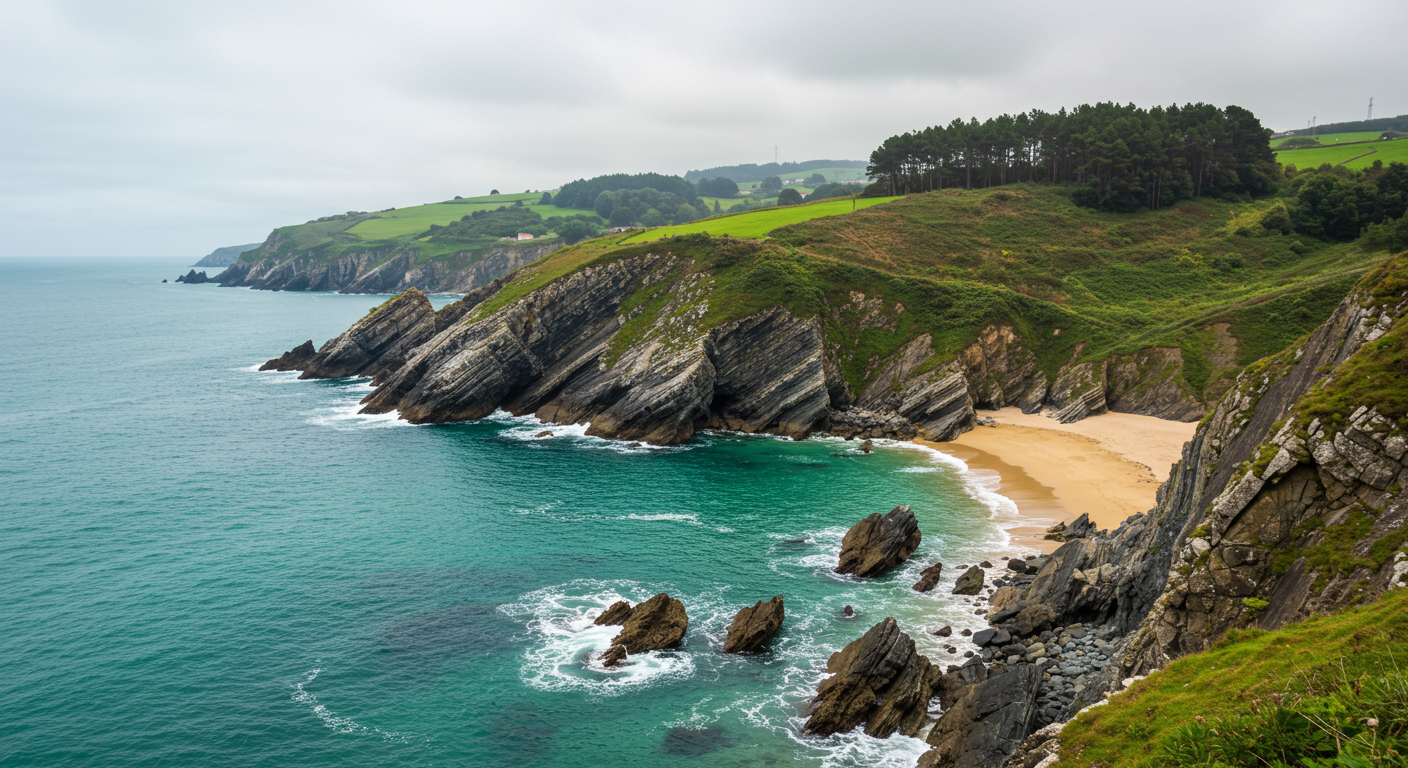
This runs along the Basque and Cantabrian coast from Irún to Santiago — around 820 km. It's arguably the most beautiful route, passing through San Sebastián, Bilbao, Santander, and the wild green coast. It's also the hilliest. You're constantly going up and down coastal cliffs rather than following river valleys, and the daily elevation gain adds up. Daily stages can be 25–30 km with 700–1,000 m ascent.
Fewer pilgrims walk it, which means longer gaps between albergues in some sections and fewer backup options if you're struggling. It's a route for people with some hiking experience and a genuine appetite for scenery over comfort.
Camino Primitivo (Original Way)
The oldest Camino, running from Oviedo through the mountains of Asturias and Galicia, around 320 km. It's beautiful and it's hard. Stages are long, the terrain is rough in places, and infrastructure is thinner than on the Francés. This is not a beginner route. I've met experienced walkers who found it humbling.
Via de la Plata (Silver Route)
Seville to Santiago, roughly 1,000 km. The longest continuous Camino. It crosses Extremadura and Castile — flat, hot in spring, brutally hot if you start too late in the season. The main practical problem for beginners is the long gaps between services. Some stages have no albergue for 30+ km. You need to be self-sufficient, carry more water, and be comfortable with uncertainty. Skip this one for your first time.
Camino Inglés (English Way)
A short route from Ferrol or A Coruña to Santiago — around 75–120 km depending on starting point. Historically used by British and Irish pilgrims who arrived by sea. It's flat, quiet, and perfectly manageable for anyone reasonably fit. The catch: it's not especially dramatic scenery, and it lacks the sense of scale that makes other routes feel like proper pilgrimages. Good if time is genuinely short.
What Nobody Tells You Before You Go
The physical challenge of the Camino is often overstated for shorter routes and understated for longer ones. The thing that gets most first-timers isn't steep hills — it's blisters and tendinitis from walking 20–25 km a day on hard surfaces when your body isn't used to it. Start training six to eight weeks before. Walk in the boots you'll actually use. Don't buy new boots the week before.
Albergues vary enormously. Municipal ones (the cheapest, typically €8–14 a night as of 2026) are usually basic: bunk beds, shared bathrooms, sometimes a kitchen. Private albergues run €15–25 and are often far more comfortable. Donativo albergues — where you pay what you can — still exist on some routes. Booking ahead is a contentious topic among pilgrims; purists think you should just walk and trust there'll be a bed. Practically speaking, on the Francés in summer, booking at least one or two days ahead prevents panic.
Food on the Camino is better than you'd expect. The menú del peregrino — a set pilgrim menu, usually three courses with wine, often €10–13 — is available at almost every stop on the Francés and Portugués. It's rarely exciting but it's filling. The Galician sections are genuinely good: pulpo a feira (octopus with paprika and olive oil) in Melide on the Francés is one of the better meals you'll eat on any walking route in Europe.
The Credential and the Compostela
Your pilgrim passport (Credencial del Peregrino) gets stamped at albergues, churches, cafés, and tourist offices along the way. You need at least two stamps per day in the final 100 km to qualify for a Compostela — the completion certificate given out at the Pilgrim Office in Santiago. The queue there can be long in summer; arriving early morning helps.
If you've walked for spiritual or religious reasons, you get a Compostela. If you've walked for other reasons — sport, tourism — you get a Certificado. It's a real question on the form. Most people tick "other reasons" and still receive the Compostela; the office doesn't interrogate you.
Costs: What You'll Actually Spend
A realistic daily budget on the Camino Francés or Portugués, walking and staying in albergues, eating the pilgrim menu: €40–60 per day. That covers a bed, breakfast (often just coffee and a pastry from a bar), the pilgrim menu at lunch or dinner, and incidentals. Budget more — €70–90 — if you want private rooms occasionally or prefer sit-down dinners. Pilgrim accommodation in Santiago itself books up fast; prices there are higher.
Gear is a one-off cost. Don't over-invest. A decent pair of broken-in trail shoes or light hiking boots, a 35–45 litre pack, trekking poles (genuinely helpful on descents), a lightweight sleeping bag liner, and a rain jacket. The Camino is not an expedition; you can buy almost anything you forgot in the towns along the way.
When to Go
May and June are the sweet spot: warm enough, green, not yet overrun. September and early October are excellent — quieter, cooler, still dry in most years. July and August are doable but crowded and hot on inland sections. The Francés in August feels like a festival at times, which some people love.
Winter walking (November to February) is quiet and atmospheric, but services are reduced, some albergues close, and Galicia in January is genuinely wet. Not impossible, but go in with realistic expectations.
If You're Planning to Stay in Spain Afterwards
A lot of people who walk the Camino end up seriously considering moving to Spain — or at least staying longer than planned. If you're in that camp, there's a fair amount of practical groundwork to do. Getting your paperwork sorted before or shortly after arrival matters: from understanding your healthcare situation before your TIE arrives to opening a Spanish bank account as a non-resident. If you're thinking about remote work or freelancing while based in Spain, the Spanish Digital Nomad Visa is worth looking at carefully before you commit.
Santiago de Compostela itself is a genuinely pleasant city to spend a few days in after finishing. The old town is compact and walkable, the market (Mercado de Abastos) is excellent for cheese, empanada, and percebes if you're feeling flush, and the cathedral square at night — once the tour groups have gone — is one of the better places to sit quietly in Spain.
Frequently asked questions
- Which Camino de Santiago route is easiest for beginners with no hiking experience?
- The Camino Portugués Central, starting from Tui (about 120 km) or Porto (about 240 km), is widely considered the most accessible for first-timers. The terrain is gentle, waymarking is clear, and albergues are plentiful. The Camino Inglés from Ferrol (75–120 km) is another low-difficulty option if time is short.
- How many days does it take to walk the last 100 km of the Camino Francés from Sarria?
- Most walkers do the Sarria to Santiago stretch in five to six days, covering roughly 20–25 km per day. It's possible to push it to four days if you're fit and don't mind longer stages, but there's no reason to rush — the infrastructure is good throughout.
- How much does it cost to walk the Camino de Santiago per day?
- On a pilgrim budget — albergue beds, pilgrim menus, coffee stops — expect to spend €40–60 per day as of 2026. Private rooms, better dinners, or taxis for bags will push this to €70–100. The main one-off cost is gear, which you can keep reasonable by not over-buying.
- Do you need to book albergues in advance on the Camino?
- On the Camino Francés in July and August, booking one to two days ahead is sensible on popular stages (particularly Pamplona, Burgos, León, and the final 100 km). On quieter routes like the Primitivo or Norte, less critical but still wise in peak season. Outside summer, walk-ins are usually fine.
- What is the Compostela certificate and how do you get it?
- The Compostela is the official completion certificate issued by the Pilgrim Office in Santiago de Compostela. To qualify, you must walk at least the final 100 km (or cycle 200 km) and collect at least two stamps per day in your Credencial del Peregrino during that section. The office is near the cathedral; bring your stamped credential and queue early in summer.
- Is the Camino del Norte harder than the Camino Francés?
- Yes, significantly. The Norte follows the Basque and Cantabrian coastline, which means constant ascent and descent over coastal terrain — daily elevation gains of 700–1,000 m are common. It's also longer (around 820 km from Irún) and has fewer services between stages. It's a beautiful route but not one for first-timers who haven't done multi-day hiking before.
- What time of year is best to walk the Camino de Santiago?
- May, June, September, and early October are the best months: reasonable temperatures, good daylight hours, and — outside July and August — manageable crowds. July and August are the busiest and hottest months; winter is quiet but wet in Galicia and some albergues close. The Camino is walkable year-round, but spring and early autumn are the most comfortable.