Canary Islands Beaches: Volcanic Sand, Dunes and Year-Round Swimming
Black lava shores, golden dunes and Atlantic swells — the Canary Islands offer extraordinary beaches in every season. Your complete guide for 2026.
Why the Canary Islands Are Different From Every Other Beach Destination in Spain
Most of Spain's celebrated coastlines — the Costa del Sol, the Balearic Islands, the Costa Brava — follow a broadly Mediterranean logic: hot, dry summers, mild winters, and a tourist season that peaks between June and September then quietly closes up. The Canary Islands operate on an entirely different set of rules.
Sitting in the Atlantic Ocean roughly 100 kilometres off the northwest coast of Africa — and closer to Morocco than to Madrid — the archipelago sits at a latitude where the temperature barely wavers across the year. In Las Palmas de Gran Canaria, the average high in January is around 21°C. In August it reaches about 28°C. The sea temperature in winter rarely drops below 18°C. This is not a summer beach destination; it is a permanent one, which is why the islands attract a steady stream of northern Europeans escaping grey skies in February just as readily as they do families in July.
But what really sets the Canaries apart — and what makes them worth a dedicated guide — is the geology. These are young volcanic islands, and that origin shapes everything: the colour and texture of the sand, the drama of the cliffs, the presence of extraordinary natural formations that exist nowhere else in Spain.
The Geology of the Sand: Black, Red, White and Golden
The single most striking thing about Canary Islands beaches, for first-time visitors, is the sand. On the older, more eroded islands of Lanzarote and Fuerteventura, wind and wave have ground ancient volcanic rock into fine golden or white grains that look almost Caribbean. On the younger, more geologically active islands of La Palma, El Hierro and Tenerife, the beaches are composed of dark basaltic sand — ranging from deep charcoal grey to an almost pure black — formed directly from cooled lava flows reaching the sea.
This is not a cosmetic difference. Black sand absorbs heat far more efficiently than pale sand, so on a sunny afternoon in July it can become genuinely hot underfoot — sandals are advisable. It also creates a dramatic visual contrast with turquoise Atlantic water that photographers find irresistible and that, honestly, never stops being arresting even after a week.
Then there is the red. Playa de la Tejita on Tenerife, overlooked by the rust-coloured volcanic cone of Montaña Roja, is one of the most visually striking beaches in Spain: broad, relatively undeveloped, and backed by that extraordinary ochre hill. It is also one of the few large nudist beaches on the island, which keeps the atmosphere relaxed and unstuffy.
Island by Island: Where to Swim and What to Expect
Fuerteventura: The Dunes Island
Fuerteventura is the second-largest island in the archipelago and the one that most rewards those who want serious, extended beach time. Its defining feature is the Parque Natural de Corralejo in the north: a protected area of wind-sculpted dunes that stretch for several kilometres, backed by nothing but desert scrub and sky. The sand here is pale gold and fine, the water clear and shallow in places, and the prevailing northerly trade winds make it one of the best windsurfing and kitesurfing destinations in Europe.
Further south, the peninsula of Jandía holds some of the longest uninterrupted stretches of beach in Spain. Playa de Sotavento — the venue for the annual Windsurfing World Championship — shifts between exposed ocean beach and a vast tidal lagoon depending on the season and the swell, creating conditions that suit both experienced wave riders and families paddling in knee-deep warm water.
As of 2026, Fuerteventura sees around 12 million tourist arrivals annually across the whole archipelago, with the island itself drawing a significant share of those seeking long beach stays rather than city breaks. Package tourism is real here, but venture even a few kilometres beyond the resort strips of Corralejo or Morro Jable and you find yourself on beaches where the only footprints are yours.
Lanzarote: Lava Fields and Turquoise Coves
Lanzarote is the most architecturally coherent island in the group, shaped by the vision of local artist and architect César Manrique, who spent decades ensuring that tourist development respected the volcanic landscape rather than burying it under concrete. The result is an island that feels genuinely distinctive: whitewashed buildings with green doors and windows, no billboards, and beaches that sit within lava fields rather than resort sprawl.
Playa de Papagayo, in the south near Playa Blanca, is a series of small coves carved into golden-red cliffs, accessible via a dirt track (a small access fee of around €3 per vehicle applies, as of 2026). The water is calm, clear and protected from the wind — rare on an island that is otherwise quite exposed. Arrive before 10am in summer and you will have it largely to yourself.
Famara, in the northwest, is the opposite: a wild, wind-battered beach backed by dramatic cliffs that plunge from the Famara massif, popular with surfers and walkers but not with families looking for calm swimming. The village behind it, Caleta de Famara, has a handful of good fish restaurants and a permanently unhurried atmosphere.
Tenerife: Contrasts on the Largest Island
Tenerife is the most visited island in the Canaries — and one of the most visited destinations in all of Europe, receiving around 6 million tourists a year as of 2026. The southern resorts of Playa de las Américas and Los Cristianos are package-holiday territory: large, well-organised, and not particularly subtle. But Tenerife is big enough that this is only one face of the island.
Playa de las Teresitas, just north of Santa Cruz de Tenerife, is an unusual case: an artificial beach created in the 1970s using sand imported from the Sahara, sheltered by a breakwater, and backed by palm trees and the green hills of the Anaga rural park. It is where locals come, which means it is busiest at weekends and relatively quiet mid-week. The water is calm and the setting — with the Anaga mountains rising behind — is genuinely beautiful.
For black sand, head to Playa de Benijo in the Anaga peninsula or the smaller Playa del Bollullo near La Orotava. These are not beaches for lounging in organised rows of sun beds; they are wild, dramatic, occasionally rough, and surrounded by some of the most spectacular coastal scenery in Spain. The hiking possibilities in the Anaga and Teno rural parks, which lead down to secluded coves, are extraordinary.
Gran Canaria: The Maspalomas Dunes
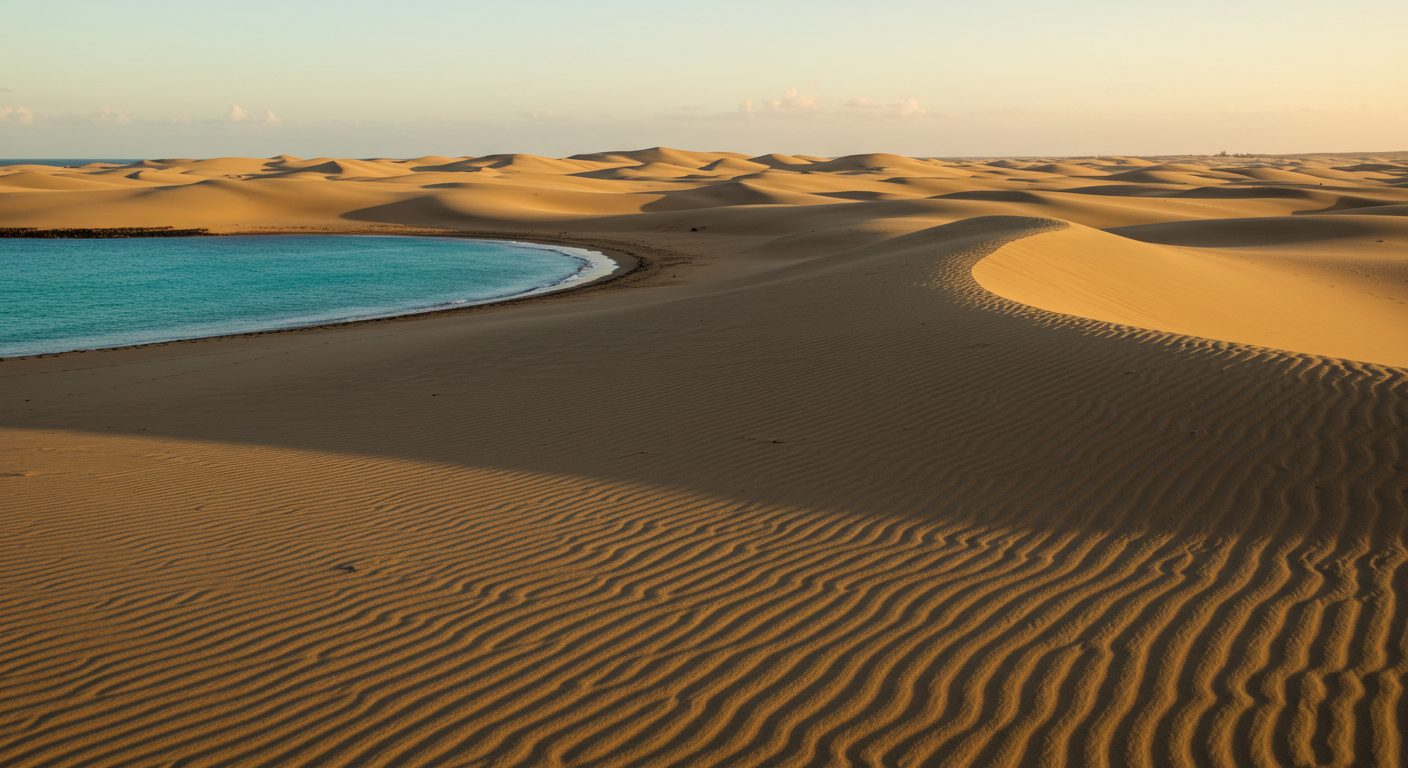
Gran Canaria's great natural spectacle is the Dunas de Maspalomas at the island's southern tip: a protected reserve of shifting sand dunes that covers around 400 hectares and meets the sea at Playa del Inglés. The dunes are a UNESCO Biosphere Reserve, and walking into them — away from the beach bars and sun-bed lines — is a genuinely disorienting experience, the kind that makes you forget you are on an island.
The beach itself runs for several kilometres and is divided informally into sections: families, gay beach, nudist area, surfers. It is one of the most tolerant and socially relaxed beaches in Spain, which partly explains its enduring popularity with LGBTQ+ travellers from across Europe.
Las Palmas de Gran Canaria, the island's capital and the largest city in the Canaries, has its own urban beach — Playa de las Canteras — that regularly appears on lists of the best city beaches in Europe. It is a long, north-facing crescent of sand protected by a natural reef (La Barra), which keeps the water calm and makes it swimmable year-round. The Paseo de las Canteras behind it is lined with restaurants and bars that stay busy in every month of the year.
La Palma, La Gomera and El Hierro: The Quiet Islands
The three smaller western islands are for those who find the main four too developed. La Palma — currently recovering from the 2021 Cumbre Vieja eruption, which added new land to the island's southwest coast — has black sand beaches like Playa de los Cancajos and the wild Playa de Nogales that require some commitment to reach. La Gomera has Playa de Santiago and Valle Gran Rey, both popular with those who like their beach days framed by dramatic ravine scenery. El Hierro, the smallest and least visited, has almost no sandy beaches at all — instead, natural lava pools like Charco Azul and Punta Grande offer swimming in sheltered Atlantic water.
Swimming Year-Round: What the Seasons Actually Mean Here
The phrase "year-round swimming" gets used loosely in Spain. In Barcelona or San Sebastián — where the Basque Country's beaches are magnificent but the Atlantic winter is genuine — it would be misleading. In the Canaries, it is simply accurate.
Sea temperatures range from around 18–19°C in February (cold for some, perfectly swimmable for others) to 23–24°C in September. The air temperature means you will not feel chilled getting out of the water even in January. The main practical consideration is the wind: the trade winds (los alisios) blow predominantly from the northeast and are strongest between June and September — the same months when mainland Spain bakes. This is why the south and west coasts of each island tend to be calmer in summer, while the north coasts are better in winter and spring.
For those considering a longer stay — whether as a tourist, a remote worker, or someone exploring the options around the digital nomad visa — the Canaries offer something genuinely rare: a place where the beach is not a seasonal amenity but a daily one.
Practical Matters: Getting There, Getting Around and What to Budget
All seven main islands have airports, with direct flights from across Europe. Ryanair, Vueling, Binter Canarias (the inter-island carrier) and several charter operators serve the islands year-round. A return flight from London to Tenerife or Gran Canaria typically costs between £80 and £250 depending on season and how far in advance you book, as of 2026.
Inter-island travel is straightforward via Binter Canarias flights (30–50 minutes between islands, from around €60 one-way) or Fred Olsen and Naviera Armas ferries, which are slower but cheaper and allow you to bring a car.
On the ground, a hire car is strongly recommended on all islands except Gran Canaria and Tenerife, where bus networks (Guaguas in Las Palmas, TITSA in Tenerife) are reasonably comprehensive. Hire car prices vary significantly by season; booking in advance through local operators or comparison sites can bring costs down to €25–40 per day for a small car, as of 2026.
Accommodation ranges from large all-inclusive resort complexes (most concentrated in the south of Tenerife and Gran Canaria) to small rural houses (casas rurales) in the interior, to apartments in the island capitals. Las Palmas de Gran Canaria in particular has developed a strong long-stay and digital nomad community, with co-working spaces, a lively food scene and rents that — while rising — remain more manageable than mainland cities.
Comparing the Canaries to Other Spanish Beach Destinations
If you are weighing up where to spend a beach holiday in Spain, the honest comparison looks something like this: the Costa del Sol offers warmer, calmer Mediterranean water in summer and excellent infrastructure; the Balearics offer more varied scenery and a stronger local culture; the Costa Brava offers dramatic rocky coves and proximity to Barcelona. The Canaries offer something none of those do: the complete absence of a "wrong season." They also offer a geological drama — dunes the size of small deserts, black lava beaches, volcanic cones rising behind the shoreline — that is simply not available anywhere else in Spain.
The trade-off is distance. The Canaries are not a weekend trip from Madrid in the way that Alicante or Tarragona might be. They require a commitment, which is also why they tend to attract visitors who stay longer and engage more deeply with the place.
The Canary Islands reward the curious. Whether you are chasing the black sand coves of Tenerife's Anaga peninsula, watching the light change over the Maspalomas dunes at dusk, or simply swimming in warm Atlantic water on a January afternoon while the rest of Europe shivers, these islands offer a version of beach life that is unlike anything else Spain has to give. Plan carefully, go in the shoulder season if you can, and leave time for the interior — because the volcanoes are as extraordinary as the shores they created.
Frequently asked questions
- Which Canary Island has the best beaches for families with young children?
- Fuerteventura and Lanzarote are generally the best choices for families. Fuerteventura's Playa de Sotavento and the beaches around Corralejo offer shallow, calm water and fine sand. In Lanzarote, Playa de Papagayo's sheltered coves are excellent for small children. Both islands have lower wave activity on their southern and western coasts, especially in summer.
- Is it safe to swim on black sand beaches in the Canary Islands?
- Generally yes, but black sand beaches are more likely to be exposed to Atlantic swells and can have stronger currents than the sheltered southern beaches. Always check for red or yellow flags, and be aware that black sand heats up significantly in direct sun — wear sandals when walking across it in summer. Beaches like Playa de Benijo in Tenerife are beautiful but not always calm enough for casual swimming.
- When is the best time of year to visit the Canary Islands for beaches?
- The honest answer is that any time works. Spring (March–May) and autumn (October–November) offer the most comfortable combination of warm air, calm seas and smaller crowds. Summer is busier and windier on north-facing coasts, but the south coasts remain calm. Winter (December–February) is genuinely pleasant — air temperatures stay around 20–22°C — and is ideal for those escaping northern European cold.
- Are the Maspalomas dunes in Gran Canaria protected? Can you walk through them?
- Yes, the Dunas de Maspalomas are a protected Natural Monument and part of a UNESCO Biosphere Reserve. You can walk through them freely, but camping, driving and removing sand are prohibited. The dunes are best explored in the early morning or late afternoon to avoid the midday heat and to see them in the most dramatic light. Stick to established paths where they exist to minimise erosion.
- Do I need a car to visit the beaches in the Canary Islands?
- On Gran Canaria and Tenerife, public buses (guaguas) reach most main beaches, particularly around the resort areas. On the other islands — Fuerteventura, Lanzarote, La Palma, La Gomera and El Hierro — a hire car is strongly recommended if you want to explore beyond the main resort areas. Many of the most rewarding beaches involve driving on unpaved tracks.
- Can I live in the Canary Islands as a remote worker or digital nomad?
- Yes, and the islands — particularly Las Palmas de Gran Canaria — have become a significant hub for remote workers and digital nomads. Spain's Digital Nomad Visa, introduced in 2023, provides a legal framework for non-EU remote workers to live in Spain. The Canaries also have a special tax regime (the Zona Especial Canaria) that can be advantageous for certain business structures. Las Palmas has co-working spaces, fast fibre internet and a year-round outdoor lifestyle that suits the remote working model well.
- What is the difference between the beaches on the north and south coasts of the Canary Islands?
- The north coasts face the prevailing northeast trade winds and tend to have rougher seas, stronger swells and more dramatic scenery — better for surfing, windsurfing and walking than for calm swimming. The south and west coasts are sheltered from the trade winds and generally offer calmer water, more reliable sunshine and the majority of the resort infrastructure. In summer, the wind difference between north and south is most pronounced; in winter, both coasts can be calm.