How to Find a Good Menú del Día in Spain (And What to Pay)
How to find a good menú del día in Spain, what it should cost in 2026, and the red flags that mean you've walked into a tourist trap.
What the Menú del Día Actually Is — and Why It Matters
The menú del día is one of the most practical facts of life in Spain. It's a fixed-price weekday lunch — typically three courses with bread, a drink, and sometimes coffee included — served between roughly 1:30 and 3:30 pm. In most Spanish cities and towns, a decent one costs between €11 and €16. In tourist-heavy areas, you'll be gouged for €18 to €22 and served something noticeably worse. Knowing the difference before you sit down will save you money every single day you live or travel here.
The short answer, if you're after one: look for a handwritten or photocopied paper menu taped to the door, a room full of Spanish office workers eating quickly, and a price under €14. That combination almost never lets you down.
Why Lunch Is the Main Meal in Spain
This isn't just a tradition that's lingered out of habit. The menú del día exists partly because of a Franco-era regulation requiring restaurants to offer an affordable workers' lunch — the idea being that labourers needed a proper midday meal. The legal requirement is long gone, but the custom calcified into culture. Spanish families still eat their largest meal at midday. Restaurants know this, and the best ones put real effort into the lunch menu because it's where the bulk of their local trade comes from.
This matters to you practically: a dish that costs €18 à la carte at dinner might appear on the menú del día for €13 the same day, at the same restaurant, cooked by the same chef. Spaniards exploit this without thinking about it. Expats who don't figure it out quickly spend a lot more money than they need to.
What a Menú del Día Should Include
The standard format, across most of Spain, is:
- A first course (primer plato): usually a salad, soup, pasta, rice, or legumes
- A second course (segundo plato): meat or fish, typically with some kind of side
- Dessert or coffee (postre o café): often a choice of fruit, yoghurt, flan, or a small ice cream — plus an espresso or cut
- Bread, usually left on the table in a basket
- A drink: a glass of house wine, beer, sparkling water, or still water
Some places include the coffee in the price; others charge 50 cents to €1 extra. Ask before you assume. In the Basque Country and parts of Catalonia, the quality of even the cheapest menú tends to be noticeably higher than the Spanish average — the regional food culture simply doesn't allow for mediocrity.
What a Menú del Día Should Cost in 2026
This varies by city and neighbourhood, but here's a realistic range as of 2026:
- Small town or village: €9–€12, often with a homemade feel and portions that are slightly alarming
- Mid-size city (Zaragoza, Valladolid, Murcia, Córdoba): €11–€14
- Madrid, Valencia, Seville: €12–€16 in working neighbourhoods; €18–€25 near major tourist sites
- Barcelona: €13–€18 in Eixample or Gràcia; €20+ in the Gothic Quarter or El Born
- San Sebastián: €14–€18, but quality is usually worth it
- Tourist coastal strips (Benidorm, Magaluf, Playa de las Américas): prices vary wildly and quality can be genuinely poor
Anything under €10 in a city is worth a raised eyebrow — not because it can't be good, but because you should check what's actually included. Anything over €18 in a non-tourist neighbourhood is either a restaurant punching above its weight or one that's decided it can get away with it.
How to Spot a Good One Before You Sit Down
This is the skill that takes a few weeks to develop, but once you have it, it's automatic.
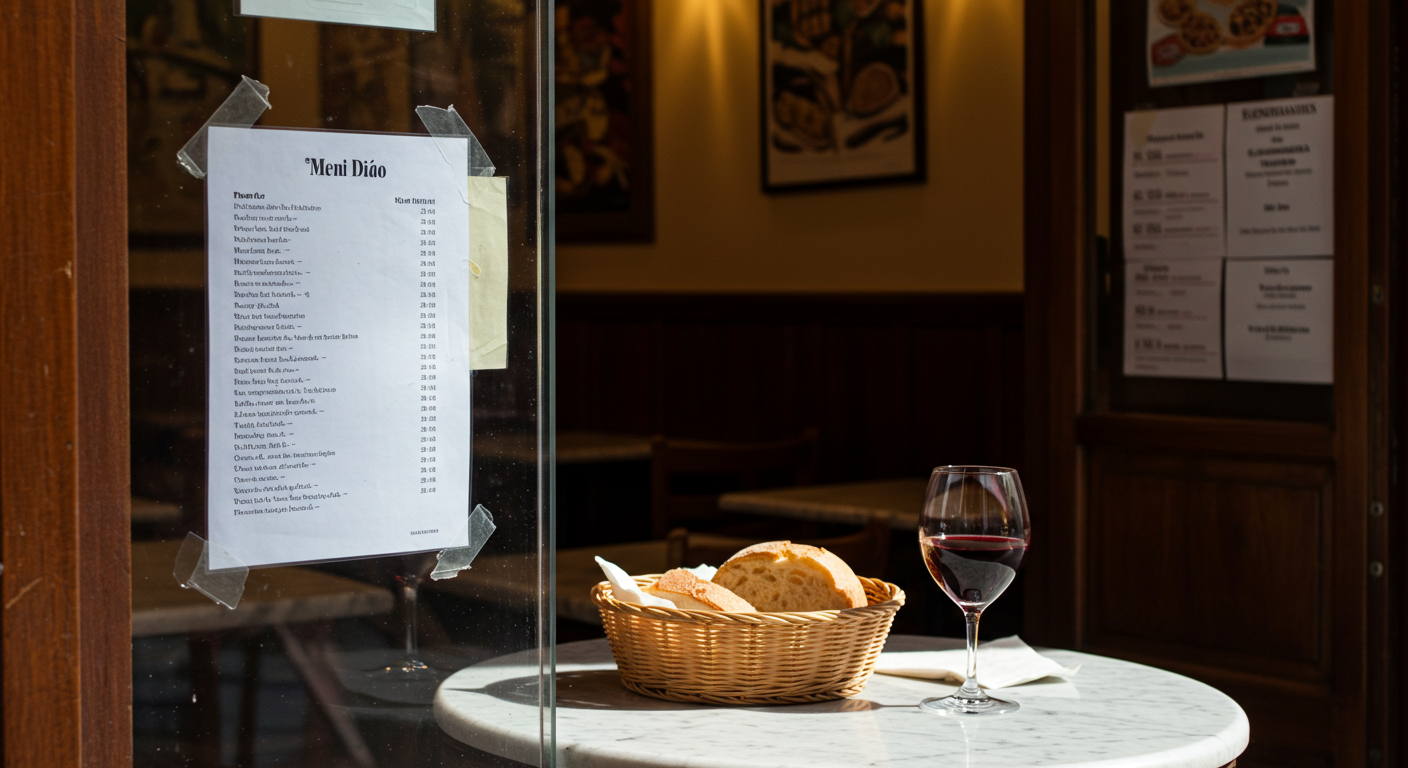
The menu on the door. A good menú del día is usually handwritten, printed on a single sheet, or chalked on a board. It changes daily or at least weekly. If the menu looks laminated and has been there since 2019, that's a sign the kitchen isn't buying fresh.
The clientele. Walk past the window. If you see a room full of construction workers, office staff, or elderly locals eating quickly and without ceremony, that's the best possible sign. If the room is mostly tourists with guidebooks, keep walking. This sounds harsh but it's almost always accurate.
The time. Turn up at 1:15 pm and you'll often get a choice of tables and the full menu. Turn up at 3 pm on a Friday and you may find they've run out of half the options. The Spanish eat late by northern European standards — 2 pm is peak — so arriving slightly before the rush has practical advantages.
The location. One street back from the main square. Near a hospital, a university, a law court, or an industrial estate. These are the places that survive on repeat local customers, which means they can't afford to be bad. The restaurant with the best paella in any given Valencian town is rarely the one with the biggest sign on the seafront.
The price displayed outside. In Spain, restaurants are legally required to display prices. If the menú del día price isn't shown, go elsewhere.
What to Actually Order
First course, go for whatever sounds regional and seasonal. In Galicia, the caldo gallego (a hearty broth with greens and beans) on a menú for €12 is often genuinely excellent. In Valencia, an arròs al forn (baked rice) at a local restaurant at lunchtime is usually far better than anything served in the evenings. In Andalusia, a gazpacho or salmorejo as a starter in summer is light and right.
Avoid anything that sounds like it was designed for international tastes — pasta with cream sauce, chicken nuggets, pizza. That's not why you're here, and it suggests the kitchen doesn't trust its own diners.
For the second course, fish on a Friday is a reliable heuristic: many kitchens have a fresh delivery for the end of the week. Pork, chicken, and beef are safer bets than lamb or game on a menú, simply because they're more forgiving at volume cooking.
Skip the dessert if it's a choice between industrial flan and tinned fruit. Get the coffee instead — a Spanish espresso after lunch is one of the genuinely non-negotiable pleasures of living here.
The Red Flags Worth Knowing
A few things that should make you hesitate:
A menu in six languages, displayed outside, with photographs. Not always bad, but the photographs are usually aspirational fiction.
A waiter who approaches you on the street and reads out the menú. This is almost exclusively a tourist-trap tactic in places like Las Ramblas in Barcelona or the Triana bridge area in Seville.
A "menú del día" that's only available at a specific time that happens to be two hours before any Spanish person eats lunch. Some tourist restaurants have started offering a fake "set lunch" at noon to catch visitors before the real lunch service begins. It's not the same thing.
No wine or beer included. Fine at a vegetarian café or a health-food place, but if a standard bar-restaurant is charging €15 for a menú and the drink isn't included, recalibrate your expectations.
Regional Variations Worth Knowing About
The menú del día is not quite the same everywhere. In the Basque Country, even a basic bar menú tends to be two courses rather than three, but the quality of the ingredients is typically higher than anywhere else in Spain. In Catalonia, you'll sometimes see a menú de degustació at lunchtime — a more elaborate tasting format at €25–€35 — which represents extraordinary value compared to what you'd pay at dinner.
In the Canary Islands, look for the menú canario rather than a generic set lunch: papas arrugadas, mojo, fresh fish. The islands have their own culinary logic and the best local places reflect it. In Galicia, portions are often genuinely enormous and the house wine is frequently a drinkable Ribeiro or Albariño that would cost twice as much in a wine shop.
If you're in the process of settling in Spain — sorting your empadronamiento, opening a bank account, or working out your healthcare situation before your TIE arrives — knowing how to eat well cheaply takes real pressure off your budget during the first months. The menú del día is not a compromise. For the first year or two of living here, it can genuinely be the best meal of your day.
A Note on the Digital Nomad Reality
If you're working remotely and thinking about Spain's digital nomad visa, the menú del día changes your cost-of-living calculations meaningfully. A couple eating lunch out five days a week on good menús — €13 each, roughly — spends around €520 a month on weekday lunches. The same meals ordered à la carte at dinner prices would cost double. This is not a trivial difference when you're budgeting a move.
The menú del día is one of those things about Spain that sounds minor and turns out to be quietly central to how daily life here works. Learn to use it well and you'll eat better, spend less, and feel a lot more at home.
Frequently asked questions
- What time is the menú del día served in Spain?
- Most places serve it from around 1:30 pm to 3:30 pm, Monday to Friday. Some extend to Saturday lunch but it's less common. Sunday is usually à la carte or a more expensive set menu. Arriving by 2 pm gives you the best choice of dishes.
- Is the menú del día available on weekends?
- Saturday lunch menús exist at many restaurants, often at a slightly higher price than weekday ones. Sunday is much rarer — most local restaurants either close or switch to a full à la carte service. Don't assume a place that does a great weekday menú will offer the same deal on a Sunday.
- How much should I expect to pay for a menú del día in Madrid or Barcelona in 2026?
- In a working neighbourhood of Madrid — Lavapiés, Carabanchel, Vallecas — you'll find decent menús for €12–€15. In tourist-adjacent areas like Sol or La Latina, €16–€20 is common for worse food. Barcelona follows similar logic: Eixample and Gràcia offer good value around €13–€17, while the Gothic Quarter charges a significant tourist premium.
- Does the menú del día always include a drink?
- In the vast majority of traditional Spanish restaurants, yes — a glass of house wine, beer, or water is included. In health-focused or vegetarian places, or very budget spots, the drink may be extra. Check the price displayed on the door: if it says 'bebida incluida', you're covered.
- Can I ask for a vegetarian menú del día?
- Increasingly yes, especially in larger cities and university towns. But in a traditional village bar-restaurant, the concept of a fully vegetarian menú may not compute. Your best bet is to ask what the first courses are — salads, soups, and pasta dishes are often meat-free by default — and then ask if the second course can be a fried egg or a vegetable dish instead of the meat option. Most kitchens will accommodate this without drama.
- Is the menú del día only for tourists, or do Spanish people actually eat it?
- Spanish people eat it constantly. It was designed for workers and it still functions that way. The best menús in any town are often in the places that cater to local office staff, tradespeople, and pensioners — not visitors. If a restaurant's menú clientele is mostly international tourists, that's usually a sign the locals have found somewhere better.
- Are there apps or websites to find good menú del día options?
- Google Maps reviews mentioning 'menú del día' are genuinely useful — search the phrase alongside a neighbourhood name. TheFork (called ElTenedor in Spain) lists set menus at participating restaurants. But honestly, the most reliable method is walking one or two streets back from wherever tourists congregate and reading the handwritten menus on doors. That still works better than any algorithm.