A Slow Guide to Valencia: Old Town, Ruzafa, Turia and the Beach
How to spend a slow week in Valencia — from the cathedral quarter and Ruzafa's café scene to the Turia gardens and the city beach. Real tips, no tourist traps.
Three days in Valencia is not enough. That's the honest answer to the question most people are actually asking when they search for a slow travel guide to Valencia's old town, Ruzafa, the Turia gardens and the beach. You can do the headline sights in 72 hours, sure — cathedral, paella, a selfie at the City of Arts and Sciences — but you'll leave having seen the postcard version of a city that rewards patience far more than most.
For a slow trip, give yourself at least five full days, ideally a week. Spend mornings on foot, afternoons hiding from the heat in a café or a covered market, and evenings eating far too late. Valencia is a city built for exactly that kind of rhythm.
The Old Town (El Carmen and the Cathedral Quarter)
Valencia's historic centre is officially called Ciutat Vella, and it contains several distinct barrios — El Carmen, La Seu, El Mercat, and a few smaller pockets. El Carmen is the one everybody talks about, and rightly so: it's a dense tangle of medieval streets that somehow avoids feeling entirely like a film set, partly because people actually live there.
Start at the Torres de Serranos, the old city gate on the northern edge of El Carmen. Free to walk up to the top on Sunday mornings (as of 2026), and the view across the rooftops towards the cathedral is worth the narrow staircase. From there, walk south without a map. Seriously. The streets are small enough that you can't get genuinely lost, and the best thing in El Carmen — the faded baroque doorways, the unexpected plazas, the bar doing coffee and a pa amb tomàquet for €2.50 — tend to be the things you find by accident.
The cathedral itself divides opinion. It's free to wander the nave, but the museum and tower (the Miguelete) cost around €5–7 each. The Miguelete is worth it — 207 steps, octagonal, and the panoramic view explains the city's geography better than any map. The cathedral claims to house the Holy Grail, which is either fascinating or absurd depending on your temperament. Skip the guided tours that pack in outside; go on a weekday morning before 10am.
For breakfast in this part of town, La Pepica de la Lonja on Carrer de la Llotja is solid — nothing fancy, but the coffee is proper and the horchata is the real thing. Avoid any place with laminated photos on the menus around the Plaça de la Reina. Every single one of them is a tourist trap.
The Mercat Central deserves an hour on its own. It's genuinely one of the finest market buildings in Europe — wrought iron, stained glass, the smell of fresh fish and citrus — and it's still a working market, not a food hall for visitors. Get there before 11am. The stallholders pack up early, and by noon it's half-empty. Pick up a bag of local oranges, some dried pimentón, and if you're self-catering, the cured fish counter in the central aisle is exceptional.
Ruzafa: The Neighbourhood That Actually Lives Up to the Hype
Ruzafa (or Russafa in Valencian) sits just south of the old town, about a 15-minute walk from the Mercat Central. It became Valencia's creative and café quarter over the last decade, and unlike some of these transformations in Spanish cities, it managed to keep enough of its original character — a working-class, immigrant-inflected barrio — to stay interesting.
The main drag is Carrer de Sueca and its surrounding streets. On a weekday morning, this is where you'll find the best café culture in Valencia. Ubik Café on Carrer de Literato Azorín is the one I keep going back to — bookshop, good espresso, no background music, tables where you can actually work or read without being rushed. Federal Café on Carrer del Mestre Clavé is the brunch spot everyone recommends, and honestly, it deserves the reputation: the eggs are good, the bread is sourdough, and the staff aren't miserable.
For dinner, Ruzafa is where Valencia's younger restaurants have landed. Canalla Bistro (Ricardo Camarena's casual spot on Carrer del Mestre Serrano) is worth booking ahead — it gets full and the kitchen does genuinely creative things with local produce without being pretentious about it. For something cheaper and less choreographed, Bar Ricardo on Carrer de Sueca has been doing bocadillos and cold beer to neighbourhood regulars for longer than most of the new places have existed. It's not fashionable. That's the point.
Ruzafa also has the best independent shopping in Valencia — small design shops, a record shop or two, a proper bookshop with titles in English. It's the kind of neighbourhood that makes you think seriously about staying. If you're considering a longer stint in the city, this is where I'd look for a flat first. (For the practicalities of renting without a Spanish payslip or setting up as a freelancer, Opening a Spanish Bank Account and Registering as Autónomo: A Complete Guide covers the financial groundwork.)
The Turia Gardens: Seven Kilometres of Green
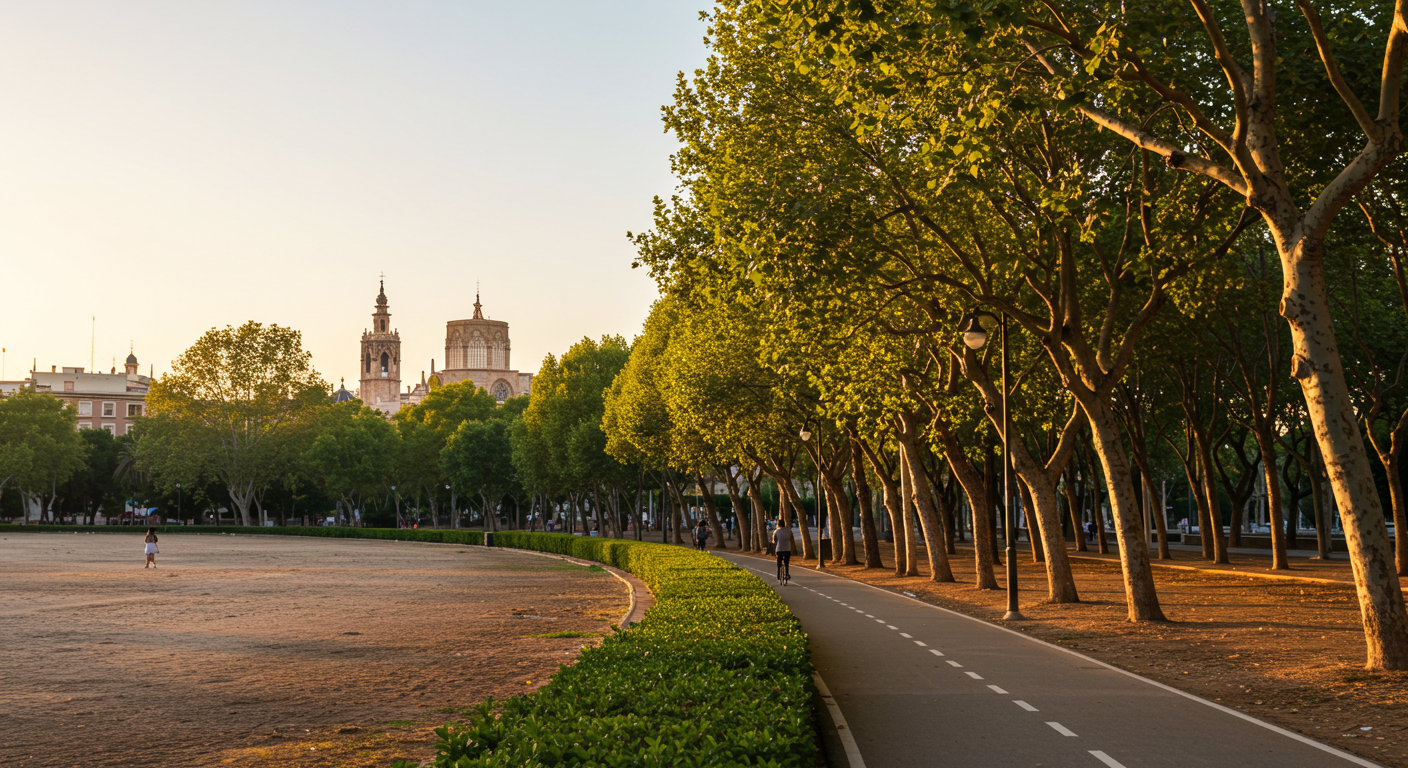
The Jardí del Túria is the defining fact of modern Valencia. The river Turia flooded catastrophically in 1957, killing around 80 people, and was subsequently diverted south of the city. The old riverbed — a dry channel running in a wide arc through the urban fabric — was eventually converted into a park. The result is a nine-kilometre green corridor that cuts through the entire city, connecting the old town to the City of Arts and Sciences at its eastern end.
For slow travel, the Turia is not optional. Rent a bike from one of the city's Valenbisi docking stations (day passes are around €2, as of 2026, and the app is straightforward) and ride the whole length in a morning. Or walk sections of it in the evening, which is what the Valencians themselves do — families, runners, old men on benches, teenagers doing tricks on bikes. The park is busiest between about 6pm and 9pm, which is also the nicest time to be in it as the light softens.
The Palau de la Música is in the Turia, about halfway along — an odd 1980s building that looks like a greenhouse and hosts regular concerts. Check the programme; tickets for midweek classical concerts can be very reasonable. The Gulliver Park, further east, is a giant sculpture of Gulliver pinned to the ground that children can climb all over. It sounds kitsch. It is kitsch. It's also brilliant.
At the eastern end, the City of Arts and Sciences is genuinely worth seeing from the outside — Calatrava's architecture is spectacular in the way that only slightly excessive things can be. The Oceanogràfic aquarium inside is the largest in Europe and perfectly good if you have children or a particular interest in marine life. Otherwise, save the €35 entrance fee and walk around the exterior at dusk, when the buildings reflect in the shallow pools.
The Beach: La Malvarrosa and Beyond
Valencia's city beach — La Malvarrosa — sits about 4km east of the old town, easily reached by tram (line 4 from the Pont de Fusta stop, roughly €1.50 each way). It's a wide, sandy beach, around 1.5km long, with the Passeig Marítim running behind it.
Honest assessment: La Malvarrosa is good, not exceptional. The water is clean, the sand is fine, and the infrastructure is solid — showers, sun loungers for hire, lifeguards in summer. But it's a city beach, and it gets genuinely crowded in July and August. If you're visiting in June or September, it's considerably more pleasant. For truly impressive beaches, the Costa Blanca south of the city (Xàbia, Altea, the calas around Dénia) is within an hour or two by car or bus, and The Best Beaches in Spain for Summer 2026 has the fuller picture.
For paella, the strip of restaurants behind La Malvarrosa is the traditional place to eat it in Valencia. La Pepica is the famous one — Hemingway ate there, photographs on the walls, etc. — and the rice is technically good, but you're paying for the legend as much as the food. La Rosa next door is marginally less touristic and equally capable. The rule with Valencian paella: order it for two people minimum, don't ask for it with seafood unless you've confirmed it's a paella de marisco (traditional Valencian paella uses chicken and rabbit), and never, ever eat it before 2pm. The kitchen isn't ready and neither is the rice.
For a slightly less packaged beach experience, the neighbourhood of El Cabanyal — just inland from La Malvarrosa — is worth exploring. It's a former fishing village absorbed into the city, with extraordinary modernist tiled houses and a neighbourhood feel that the beach strip entirely lacks. There's a small covered market, a handful of decent bars, and a regeneration project underway that's changing the character slowly. Go now, before it's finished.
Getting the Pace Right
Valencia is a city that makes more sense the slower you go. The old town for mornings, Ruzafa for afternoons and evenings, the Turia any time you need to breathe, the beach when the heat demands it. That's the basic rhythm. Stick to it, resist the urge to tick things off a list, and you'll leave understanding why so many people who come here for a week end up staying considerably longer.
If you're thinking seriously about making Valencia a longer base — as a remote worker, a retiree, or someone relocating with family — the practical steps are covered in detail elsewhere on this site. Getting Your NIE and TIE in Spain: A Step-by-Step Guide for New Residents is the place to start on the paperwork front, and if the slow-travel approach to city living appeals more broadly, A Slow Travel Guide to Granada: How to Actually Live the City is worth reading alongside this one.
Come in May or October if you can. The light is extraordinary, the tourists are manageable, and the city is — for once — actually living at its own pace.
Frequently asked questions
- How many days do you need for a slow trip to Valencia?
- Five to seven days is the honest minimum for a slow travel approach to Valencia. Three days covers the main sights, but you need at least five to properly explore the old town, spend time in Ruzafa, cycle the Turia gardens, and get to the beach without feeling rushed.
- Is Ruzafa safe to walk around at night?
- Yes, Ruzafa is generally safe at night. It's a lively residential neighbourhood with plenty of people out until late, especially on weekends. Standard urban common sense applies — don't leave bags unattended at café terraces — but it's not an area that requires any particular caution.
- What's the best way to get from Valencia's old town to the beach?
- The tram (line 4, departing from Pont de Fusta near El Carmen) is the easiest and cheapest option — around €1.50 each way as of 2026, and it drops you directly at the Malvarrosa/Eugènia Viñes stop right on the seafront. The journey takes about 20 minutes. A taxi costs roughly €8–12 depending on traffic.
- Where should you eat authentic Valencian paella in Valencia?
- The traditional place to eat paella in Valencia is the strip of restaurants behind La Malvarrosa beach — La Pepica and La Rosa are the best-known, and both do the real thing with chicken and rabbit. Avoid any place in the old town advertising paella as a tourist menu special; it's rarely cooked properly. Real Valencian paella takes 20–25 minutes to prepare and is served for a minimum of two people.
- Is the Valenbisi bike hire easy to use as a visitor?
- Fairly easy, yes. You need a credit or debit card and either the Valenbisi app or a tourist card (available at the main tourism offices). A one-week tourist subscription costs around €13.30 as of 2026. Journeys under 30 minutes are free with the subscription, which covers almost everything you'd want to do in the city.
- What's the best neighbourhood to stay in for a slow visit to Valencia?
- Ruzafa is the best base for most slow travellers — good cafés, independent restaurants, quieter streets than the old town, and easy walking distance to the Turia and the main sights. El Carmen (the heart of the old town) is atmospheric but can be noisy at weekends. El Cabanyal is interesting if you want a neighbourhood feel close to the beach, though accommodation options are more limited.
- When is the best time of year to visit Valencia slowly?
- May and October are the sweet spots. The weather is warm but not punishing (typically 22–27°C), the beach is swimmable, and the city isn't overwhelmed with visitors. July and August are brutal — temperatures regularly exceed 35°C and La Malvarrosa gets very crowded. March is worth considering if you want to catch Las Fallas, though the city is extremely busy for the festival week.